Needs and context — Start with a genuine problem in home, school, work or leisure. Identify users, tasks and constraints before deciding on a product. Needs concern essential function or access; wants concern preferences. Investigations may show that a brief must change rather than confirming the first idea.
Primary research — Interviews, observations, questionnaires and focus groups collect information directly. Ask neutral questions and include relevant users; a leading question or tiny convenient sample can mislead. Obtain appropriate consent and handle personal data respectfully, recording limitations rather than inventing findings.
Secondary research — Existing product information, books, reliable websites and anthropometric datasets are secondary sources. Check date, population, method and credibility. Compare sources with primary findings; copying a manufacturer's claim is not an independent performance test.
Product analysis — Compare function, users, materials, manufacture, appearance, cost, ergonomics and environmental/social impacts of existing products. Inspect construction and test performance appropriately. Explain how findings alter a decision; a list of attractive features without conclusions does not inform design.
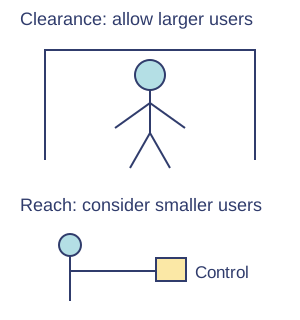
Anthropometry and ergonomics — Anthropometry measures human dimensions; ergonomics fits products and tasks to people. For clearance, allow for larger relevant users; for reach, consider smaller relevant users. Percentile data describe a population and measurement, not one universally average person. Consider disability, clothing and posture.Use percentiles for the task. Original schematic; apply the qualifications in the explanation.View full-size diagram
Research data — Summarise survey counts and proportions without claiming more accuracy than the sample supports. If 18 of 30 relevant users prefer a larger handle, that is 60% of this sample. Check open responses and observed tasks before making a design change; preference alone does not prove safety.
Brief and specification — A brief states the problem, intended users and broad outcome; a specification lists justified requirements such as function, size, cost, material, safety and sustainability. Use measurable criteria when possible: a shelf supporting a stated load is testable, unlike 'must be good'.
Challenges and ethics
Opportunities and constraints — Environmental and social challenges can stimulate repairable designs, reduced packaging or inclusive controls. Economic constraints include budget, tooling and viable selling price. Weigh compromises: a costly durable part may reduce replacement costs but exclude some buyers. Explain evidence for the chosen balance.
Responsible design — Consider deforestation, greenhouse gas emissions, pollution, fair trading and worker welfare through the supply chain. Avoid superficial green claims and culturally insensitive decoration. State the evidence and limits of sustainability claims and test whether the product still serves its users.
Designers and companies
Studying others — AQA requires investigation of at least two listed designers and two listed companies. Use those your teacher has taught and analyse actual dated examples with credible sources. These pages explain transferable methods; no school choice or prescribed product is assumed. Distinguish inspiration from copying a protected design.
Harry Beck example — Beck's diagrammatic Underground map was developed in 1931 and published in 1933. It simplified geographical detail to emphasise routes and connections for travellers. Analyse information hierarchy and usability against the actual map; the diagram does not give accurate walking distances. This is an illustrative listed designer, not an assumed school choice.
William Morris example — Morris drew on historical craft and natural forms in textiles, wallpaper and other work. Analyse an actual pattern's repetition, colour and production method, then consider how craft, cost and access interact. Compare communication and decoration with Beck's functional map without reducing either designer to a single style label.
Braun example — Braun's product design history emphasises clarity, function and simplicity, associated with teams including Dieter Rams. Examine a documented appliance's control arrangement, form, materials and usability rather than assuming minimal appearance guarantees access or repair. Braun is a listed company; Rams here is contextual, not a replacement for a listed-designer study.
Dyson example — Dyson's DC01 launched in 1993 after development of cyclonic dust separation. Study how the bag-clogging problem, prototypes, separation system and commercial constraints shaped the product. The company's history is evidence of its account, not independent proof of every performance claim. Compare measured usability, repair, energy and cost with another product.
Design analysis framework — For each example, identify context, users, form, materials, processes and its intended function. Compare its advantages and limitations, including access and environmental impact. A recognisable style is evidence only when linked to features of the actual work.
Comparison and influence — Compare two works using common criteria and then state how an insight informs an original proposal. For example, simplify a control layout after testing how users interpret hierarchy. Credit the source and test the adaptation; the original designer's reputation does not prove your design works.
Test yourself
30 questions · Random sets of 10. These quick checks support revision; practise longer explanations and justified judgements too.
Mind map
Use the branches to recall the ideas and explain their connections. Check the revision notes for the full detail.
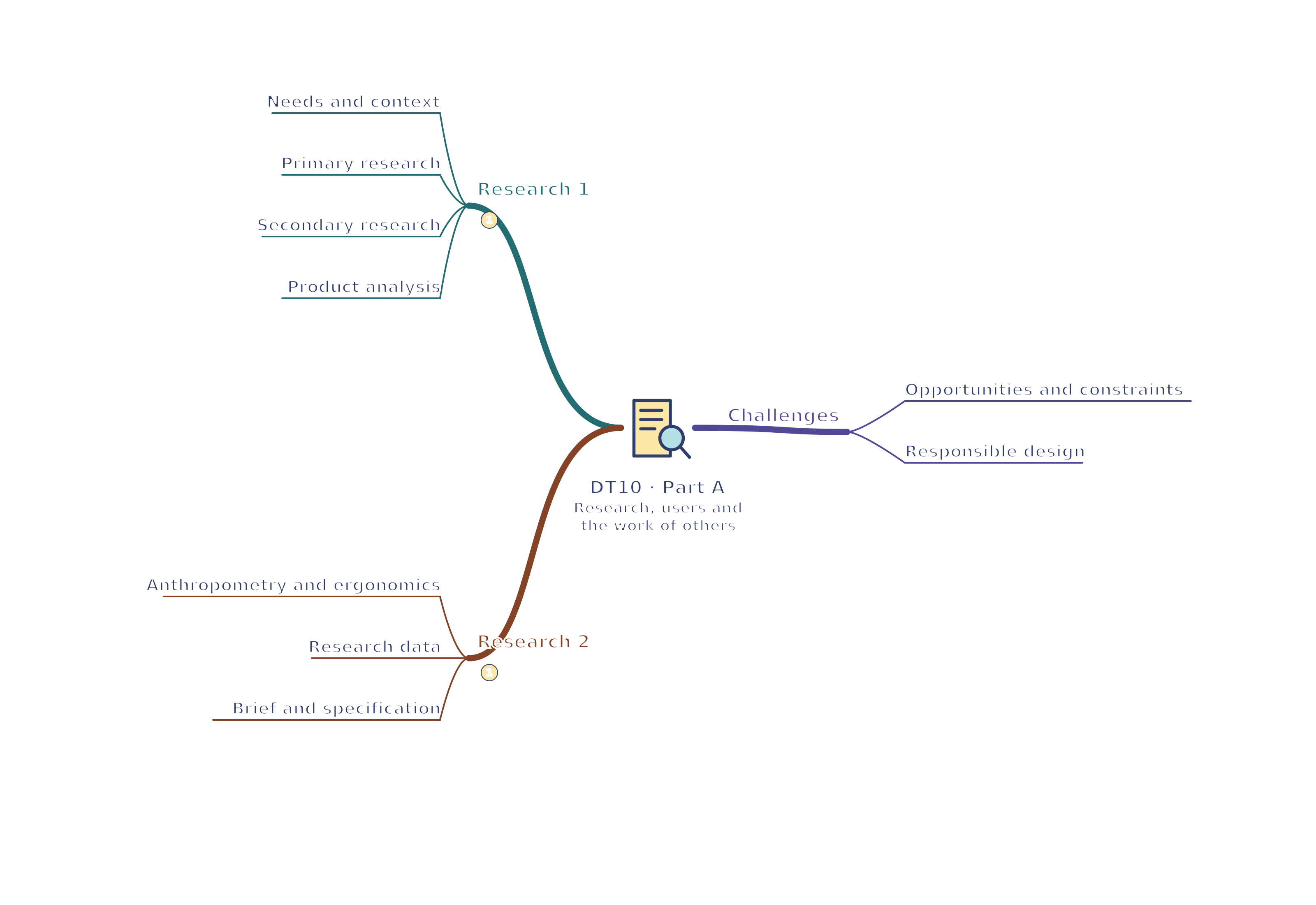
DT10 · Research 1 / Research 2 / Challenges
View DT10 · Research 1 / Research 2 / Challenges mind mapOpen the full-size map to zoom. Download the PDF to print on A4 or enlarge to A3.
 Mr Kidman's Classroom