Polymer production — Many polymers are made from petrochemical feedstocks. Crude oil is refined, fractions can be cracked to provide smaller molecules and monomers are chemically joined into polymers. Some feedstocks are renewable, but bio-based does not automatically mean biodegradable or suitable for home composting.
Thermoplastic examples — Acrylic offers transparency and a polishable surface but can be brittle; HIPS is impact-modified for formed packaging. Polypropylene is light and useful for living hinges; polyethylene suits films or containers depending on grade. PVC can be rigid or flexible through formulation.
HDPE and PET — High-density polyethylene is a tough thermoplastic used in suitable containers and pipes. Polyethylene terephthalate is used for clear bottles and, in fibre form, polyester textiles. Processing grade and test evidence matter; identifying a polymer family does not establish food contact, reuse or temperature suitability by itself.
Thermosetting examples — Epoxy bonds and encapsulates; melamine-formaldehyde provides a hard heat-resistant surface; phenol-formaldehyde suits heat-resistant electrical uses. Cross-linking prevents simple remelting after curing. Heat resistance has limits: no polymer should be described as unable to burn or degrade.
Polyester and urea resins — Cured polyester resin forms a thermoset matrix in suitable reinforced products; it differs from thermoplastic PET despite the shared word polyester. Urea-formaldehyde is used in suitable adhesives and moulded applications. Match resin, cure and safety controls carefully; emissions and chemical handling need approved procedures.
Additives — Pigments add colour; plasticisers increase flexibility in suitable polymers; UV stabilisers slow sunlight degradation. Fillers or reinforcements change properties and cost. Evaluate migration, durability, material compatibility and recycling rather than assuming an additive only has benefits.
Seating and fittings — Polymer seating needs adequate stiffness, toughness, stability and resistance to weather or cleaning. Electrical fittings need suitable insulation and temperature/fire performance. Match the grade to tested requirements; a recycled polymer of unknown composition is not automatically safe for these uses.
Stock and shaping
Stock forms — Polymers come as sheets, rods, films, foam, powder and granules. Thickness or gauge, size and grade affect processing. Standard hinges and fasteners must distribute loads without splitting or excessive creep; include machining, shrinkage and trimming allowances when estimating quantities.
Cutting and drilling — Select tools/settings for the polymer to reduce melting, chipping or cracking. Secure work, support the exit side of a drilled hole where appropriate and avoid overtightening fasteners. Laser cutting requires verified material compatibility: PVC must not be laser cut because hazardous corrosive gases can be produced.
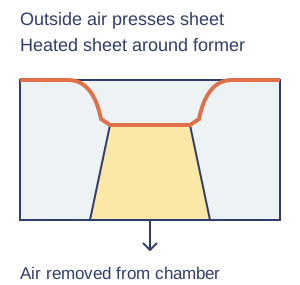
Vacuum forming — A suitable thermoplastic sheet is clamped, heated and drawn around a former by a pressure difference when air is removed. Cool before release and trim. Draft angles and appropriate vents aid release and detail; undercuts can trap the former and thickness varies during stretching.Vacuum forming cross-section. Original schematic; apply the qualifications in the explanation.View full-size diagram
Injection moulding — Granules are heated, forced into a closed mould, cooled and ejected. Complex repeated parts justify expensive tooling at high volume. Mould design must account for shrinkage, flow and release; setup cost makes it less suitable for a single simple classroom prototype.
Extrusion and blow moulding — Extrusion pushes softened polymer through a die for a continuous section such as pipe. Blow moulding inflates a hot polymer form inside a mould to make hollow objects. Neither should be confused with cutting a shape from sheet; tooling and cooling affect quality.
Drape forming and bending — A heated sheet can drape over a former; line bending heats a controlled strip before forming an angle. Temperature, bend radius and support affect appearance and accuracy. Use approved heating equipment and ventilation; do not attempt arbitrary heating of an unidentified polymer.
Casting, printing and joining — Suitable resins can be cast and cured; 3D printing adds material layer by layer from a digital model. Adhesive bonding, solvent welding and heat welding depend on polymer compatibility. Printed layers may give directional strength and need supports; compare function and finish after testing.
Finish and environmental impact
Quality and finishing — Check dimensions, warping, sink marks and function against the drawing. Polishing smooths suitable surfaces, printing adds information and vinyl decals add graphics. Use compatible preparation and coatings; laser settings influence cut dimensions but do not replace measurement or material safety checks.
End of life — Identify polymers for sorting, minimise incompatible bonded layers and allow repair/disassembly. Thermoplastics can often be reprocessed with appropriate sorting; contamination and degradation limit quality. Thermosets cannot simply remelt, though other recovery routes exist. Recycling is not the same as harmless litter disposal.
Test yourself
30 questions · Random sets of 10. These quick checks support revision; practise longer explanations and justified judgements too.
Mind map
Use the branches to recall the ideas and explain their connections. Check the revision notes for the full detail.
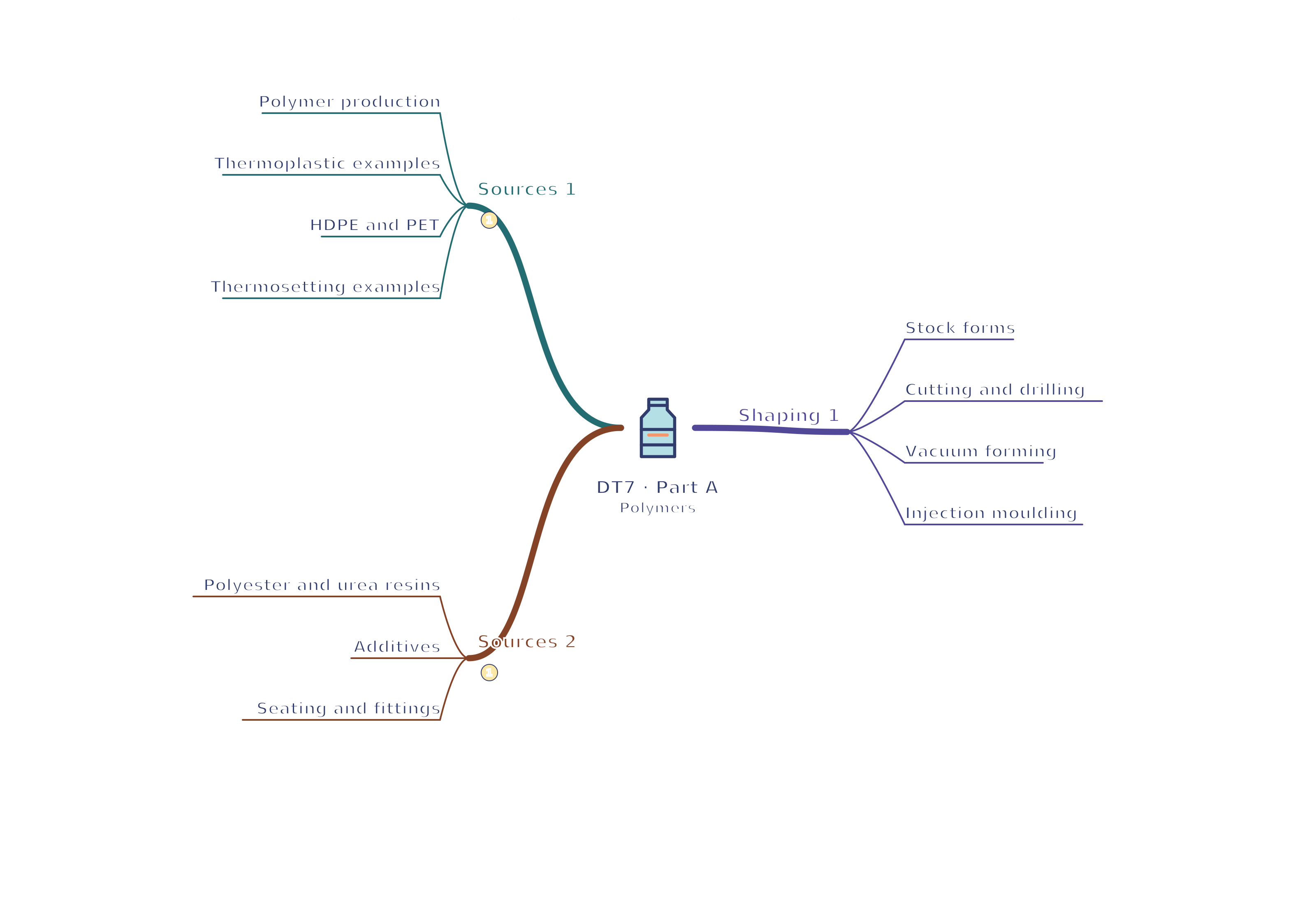
DT7 · Sources 1 / Sources 2 / Shaping 1
View DT7 · Sources 1 / Sources 2 / Shaping 1 mind mapOpen the full-size map to zoom. Download the PDF to print on A4 or enlarge to A3.
 Mr Kidman's Classroom