Property selection — Physical properties include density, conductivity and resistance to moisture. Mechanical properties describe behaviour under forces: strength, stiffness, hardness, toughness and elasticity are different. A strong material may bend easily or fracture suddenly; choose the property that matches the failure risk.
Physical property meanings — Density is mass per volume; absorbency describes taking in liquid rather than resisting moisture; fusibility describes suitability for melting/fusing. Thermal conductivity transfers heat and electrical conductivity supports current flow. Test the relevant condition: an absorbent cloth and a moisture-resistant container need different responses to water.
Strength and hardness — Strength concerns resisting a specified load before failure, such as tensile or compressive strength. Hardness concerns resistance to indentation, scratching or wear. A hard cutting edge may be brittle; toughness matters when shocks are expected. Quote the relevant property and load rather than using 'strong' for every performance need.
Working properties — Malleability is the ability to deform under compression without cracking; ductility allows drawing into wire. Elastic deformation reverses when the force is removed; plastic deformation remains. Explain how a property helps both manufacture and use, such as bending a ductile metal bracket.
Paper and board families — Paper is formed from bonded cellulose fibres; boards are generally thicker and stiffer. Cartridge paper suits drawing, layout paper supports visualising, tracing paper transmits light, and bleed-proof paper limits ink spread. Corrugated board gains bending stiffness from its fluted core; coatings affect recycling.
Timber families — Hardwood and softwood classify botanical origin, not a guaranteed hardness. Oak, mahogany and balsa are hardwoods; pine, cedar and larch are softwoods. Manufactured boards include plywood, MDF and chipboard. Natural grain, defects, moisture and board composition affect selection.
Metal families — Ferrous metals contain iron; many rust unless protected. Mild steel is tough and workable; high-carbon steel can be hardened for cutting edges; cast iron is hard but relatively brittle. Stainless steel resists corrosion through alloying. Aluminium, copper, zinc, brass and bronze are non-ferrous examples.
Polymer families — Thermoplastics soften when heated and can be reshaped within suitable conditions; thermosetting polymers form cross-linked structures and cannot simply be remelted. Acrylic, HIPS, PVC, polypropylene and polyethylene are thermoplastics. Epoxy, melamine-formaldehyde and phenol-formaldehyde are thermosets.
Textile families — Cotton and linen come from plants, wool and silk from animals. Polyester, nylon and acrylic are synthetic fibres. Blending can combine properties but may complicate recycling. Woven, knitted and non-woven structures affect stretch, drape, strength and fraying independently of fibre type.
Selection and environmental impact
Selection criteria — Compare function, ease of working, appearance, availability, cost, environmental impact and cultural/social/ethical factors. A suitable product needs a justified compromise: a cheap material may create high repair costs. Compare evidence for the same intended use rather than claiming one material is always best.
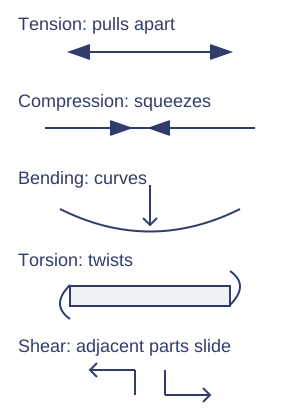
Forces and stresses — Tension pulls apart, compression squeezes, bending curves a member, torsion twists it and shear makes adjacent parts slide. Bending usually creates tension on one side and compression on the other. Orient fibres, sections and joints to resist the actual load.Five loading types. Original schematic; apply the qualifications in the explanation.View full-size diagram
Reinforcement — Lamination bonds layers; folds and ribs increase section depth and bending stiffness without simply adding a solid mass. Webbing reinforces textile load paths; interfacing stabilises selected fabric areas. Reinforcement depends on adhesion and direction, and may make repair or recycling harder.
Six Rs — Rethink whether the product is needed; refuse avoidable harmful purchases; reduce material/energy demand; reuse without reprocessing; repair faults; recycle into new material. Recycling still needs collection and processing, so design for long useful life and separation as well as recovery.
Life cycle assessment — An LCA considers extraction, processing, manufacture, transport, use and end of life. Compare like-for-like functions and lifetimes, including maintenance and energy. A heavier reusable product may outperform a disposable one after enough uses; uncertainty in data should remain explicit.
Ecological footprint — Mining, drilling, farming and logging can disturb habitats, use water and cause pollution. Transport distance alone does not establish impact: mode, load and energy source matter. Carbon dioxide from processes and energy contributes to climate change; distinguish it from particulate pollution.
Social footprint — Evaluate working conditions, pay, health, community effects and pollution borne by others across the supply chain. Traceable sourcing and relevant certification provide evidence but do not remove the need for scrutiny. FSC certification concerns forest management and chain of custody, not every product impact.
Production and quality
Stock and standard parts — Materials are sold in standard sheets, rolls, rods, tubes and boards with specified dimensions. Standard screws, hinges, zips and electronic parts can save time, cost and development. Check the actual size, specification and compatibility rather than assuming all standard parts are interchangeable.
Production scales — A prototype tests a proposal; one-off production makes a unique item. Batch production makes a set before changing setup; mass production makes large numbers of similar items; continuous production runs a process with little interruption. Demand, tooling costs, variety and consistency guide the choice.
Production aids — A datum is a reference point, line or surface for measurements. A template guides a shape; a pattern guides cutting or assembly; a jig holds or guides work or a tool. A depth stop controls travel. These aids improve repeatability but must be accurately made and checked.
Tolerances and quality — A tolerance specifies allowable variation, such as 20 ± 0.5 mm. Quality control checks measurable features during or after manufacture; quality assurance plans systems to prevent defects. Check critical dimensions and function using an appropriate gauge, recording rejection and corrective action.
Material efficiency — Nest shapes to reduce offcuts, account for grain or pattern direction, and include kerf, seams and finishing allowances. Area alone cannot prove pieces will fit a stock sheet. Compare a scaled cutting layout before buying; reuse suitable waste without compromising safety or performance.
Test yourself
30 questions · Random sets of 10. These quick checks support revision; practise longer explanations and justified judgements too.
Mind map
Use the branches to recall the ideas and explain their connections. Check the revision notes for the full detail.
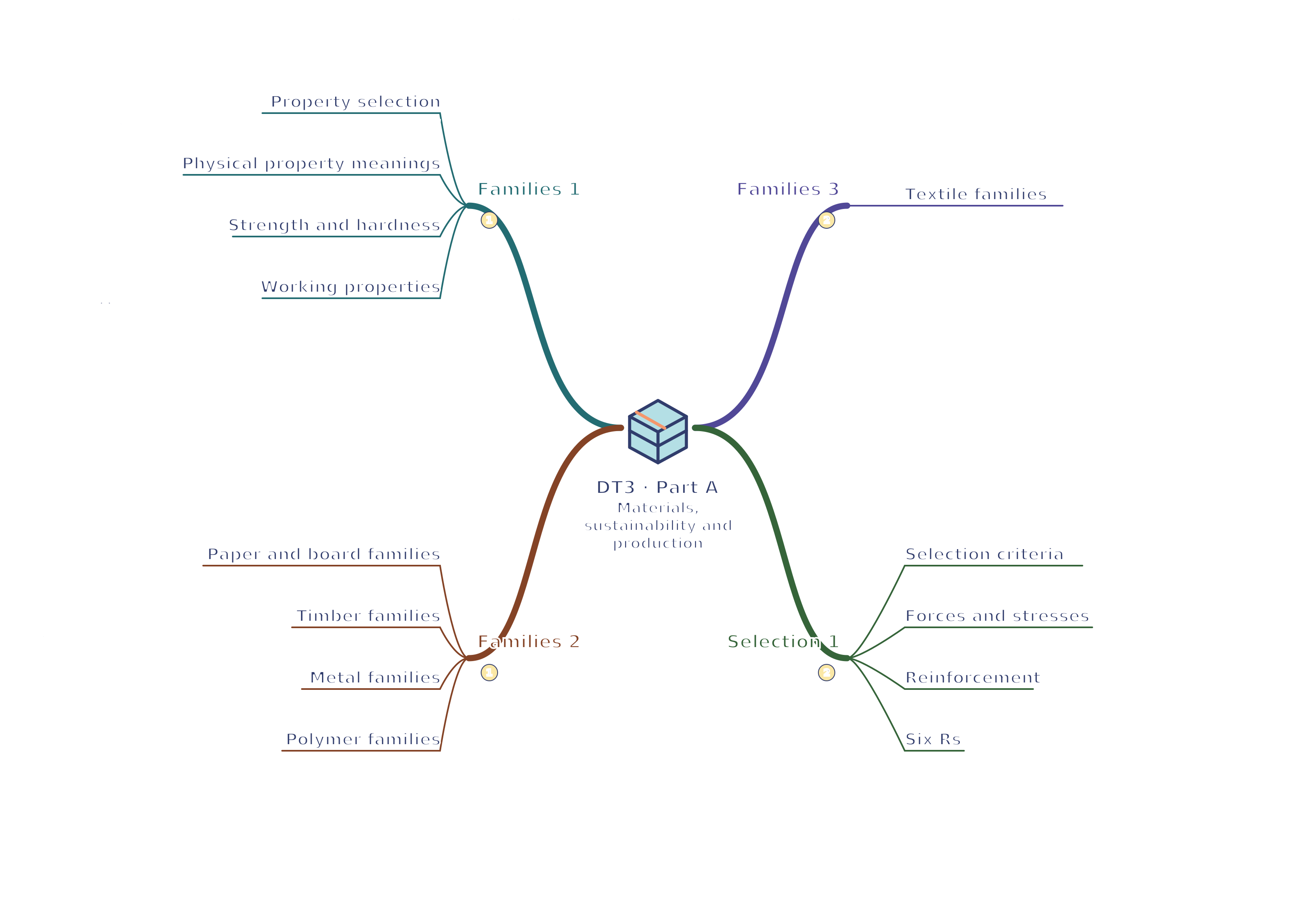
View DT3 · Families 1 / Families 2 / Families 3 / Selection 1 mind mapOpen the full-size map to zoom. Download the PDF to print on A4 or enlarge to A3.
 Mr Kidman's Classroom