Automation — Automated equipment follows programmed instructions to perform tasks such as cutting or assembly. Robots can repeat precise movements and work in hazardous areas; investment, programming, maintenance and retraining are costs. Human judgement remains important for unusual faults and design decisions.
Workplaces — Digital communication can support remote design teams and flexible workplaces. Networked machinery can share production data, but connectivity, cybersecurity, power supply and accessible working conditions need planning. New tools change jobs rather than guaranteeing that every job disappears.
Enterprise — An entrepreneur develops an idea into a viable product or service. Innovation must solve a real problem and reach customers at an affordable cost; a new material alone does not guarantee commercial success. A prototype and user testing reduce uncertainty before investment.
Crowdfunding — Crowdfunding collects many contributions through a platform to finance a proposal. It can test interest and raise funds, but delivery commitments, platform charges and production risks remain. Backers are not necessarily investors owning shares.
Virtual retail — Online marketing and shops can reach distant customers and reduce some premises costs. Customers need accurate product information and accessible interfaces; distribution, returns, data protection and misleading advertising still matter.
Co-operatives and fair trade — A co-operative is owned and controlled by its members. Fair trade seeks better terms and working conditions for producers through relevant standards and trading arrangements. A label should be checked against its actual scheme; it does not establish that a product has no environmental impact.
Technology push and market pull — Technology push starts with a technical advance that creates product possibilities. Market pull starts with an identified user demand. A lighter battery may enable a new tool, while demand for easier transport may stimulate battery development; both influences can interact.
Culture and inclusion — Designers consider changing fashions, faiths, beliefs, disability, age and social expectations without stereotyping users. Test an inclusive proposal with relevant people. Aesthetic choices and advertising can exclude a group even when the mechanism works.
Society and environment — Technology can improve communication and access while creating waste, unequal access or new hazards. Examine who benefits, who bears costs and the whole product life. Finite resources can run out; renewable resources require replenishment and responsible management.
Production systems — Flexible manufacturing can switch between variants; lean manufacture reduces avoidable waste, stock and delays. Just-in-time delivery reduces stored inventory but is vulnerable to disruption. Planned obsolescence deliberately limits useful life and can increase sales and waste.
Energy generation and storage
Thermal generation — In a typical fossil-fuel power station, combustion heats water to produce steam that drives a turbine connected to a generator. In a nuclear station, controlled fission provides heat for the steam cycle. Turbine and generator are different devices; cooling and transmission also influence efficiency and environmental impact.
Fossil fuels and nuclear — Coal, oil and gas are finite fuels; combustion transfers stored chemical energy and releases carbon dioxide. Nuclear fission transfers nuclear energy without combustion during generation, but fuel supply, radioactive waste, decommissioning and safety require management. Neither is renewable.
Renewable generation — Wind drives a turbine, solar photovoltaic cells convert light to electricity, and flowing water drives hydroelectric or tidal turbines. Output depends on location and conditions. Tidal timing is predictable; wind and sunlight vary. Renewable does not mean impact-free.
Biomass — Biomass stores chemical energy in biological material. It can be replenished but needs land, water and time. Combustion releases carbon dioxide; the net impact depends on regrowth, processing, transport and land-use change, so it is not automatically carbon neutral.
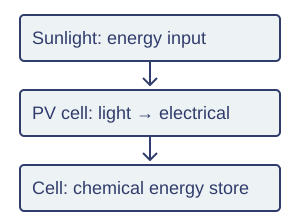
Energy conversion and storage — Energy changes form rather than being created by a generator. A photovoltaic panel converts light to electrical energy; a rechargeable cell stores energy chemically for later transfer. Springs store elastic energy and elevated water stores gravitational energy. A store is not an endless source.Energy conversion and storage. Original schematic; apply the qualifications in the explanation.View full-size diagram
Cells and batteries — A cell supplies a potential difference through chemical reactions; a battery combines cells. Primary cells are replaced when exhausted; suitable secondary cells can be recharged. Match voltage, capacity, current capability and safe charging to the product rather than mixing incompatible types.
Alkaline and pumped storage — Common primary alkaline cells are convenient replaceable stores but should not be charged unless explicitly designed as rechargeable. Pumped storage uses electricity to pump water uphill, storing gravitational potential energy; later released water drives a turbine-generator. Flywheels store kinetic energy in rotation. Storage returns less energy than was supplied because of losses.
Power choices — Mains power suits fixed high-demand appliances but requires safe insulation and connection. Batteries improve portability but add mass and need replacement or charging. Consider runtime, standby use, efficiency, user safety and accessible charging when choosing a supply.
Developments in materials
Modern materials — Modern materials are developed or improved for useful properties. Metal foams can combine low density with energy absorption; graphene is a carbon sheet with exceptional properties but product performance depends on manufacture. Coated metals improve corrosion resistance; LCDs control transmitted light in displays.
Titanium and nanomaterials — Titanium combines useful strength-to-mass ratio with corrosion resistance, but extraction and machining can be costly. Nanomaterials have structures on extremely small scales and can change surface or mechanical behaviour. Evaluate a specific application and safety evidence; the label 'nano' is not proof of superior performance in every product.
Smart materials — Smart materials change properties in response to a stimulus. Thermochromic pigments change colour with temperature; photochromic pigments respond to light. A shape-memory alloy can return towards a trained shape when heated; these responses require suitable operating conditions.
Composites — A composite combines distinct materials to obtain a useful set of properties. Glass fibres reinforce a polymer in GRP; carbon fibres can provide stiff lightweight structures. Concrete resists compression while steel reinforcement carries tension. Properties depend on constituent arrangement and bonding.
Technical textiles — Technical textiles prioritise performance such as protection, medical use or weather resistance. Breathable waterproof membranes allow water vapour movement while resisting liquid penetration under specified conditions. Conductive fabrics can carry electrical signals; evaluate washability, durability and safety.
Enhanced fibres — Aramid fibres such as Kevlar can provide high tensile strength for reinforcement or protection; performance depends on construction and testing. Fire-resistant fabrics reduce specified heat/fire hazards. Microfibres are very fine fibres; microencapsulation encloses substances in tiny capsules that can release scent or another active substance under designed conditions.
Test yourself
30 questions · Random sets of 10. These quick checks support revision; practise longer explanations and justified judgements too.
Mind map
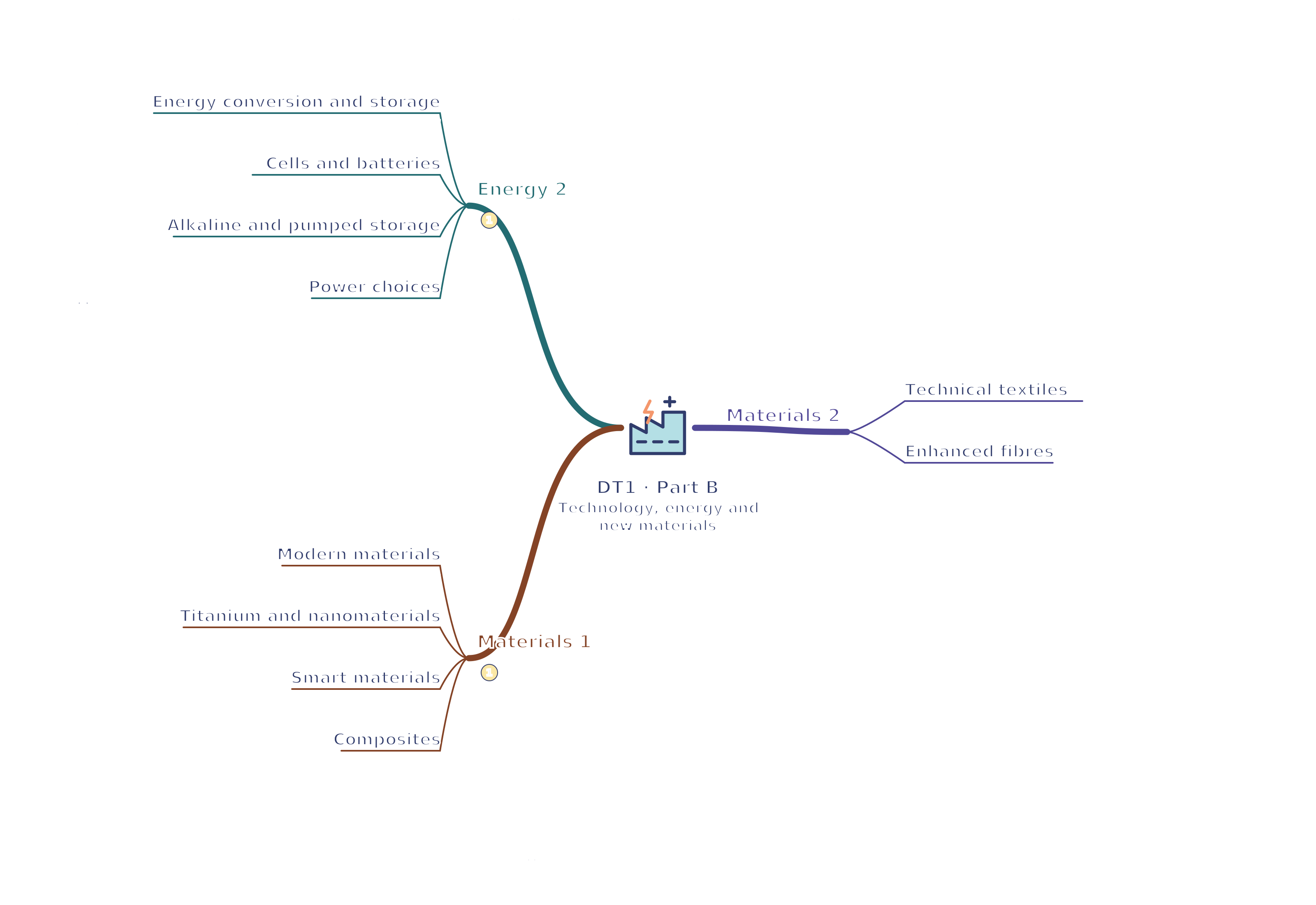
Use the branches to recall the ideas and explain their connections. Check the revision notes for the full detail.
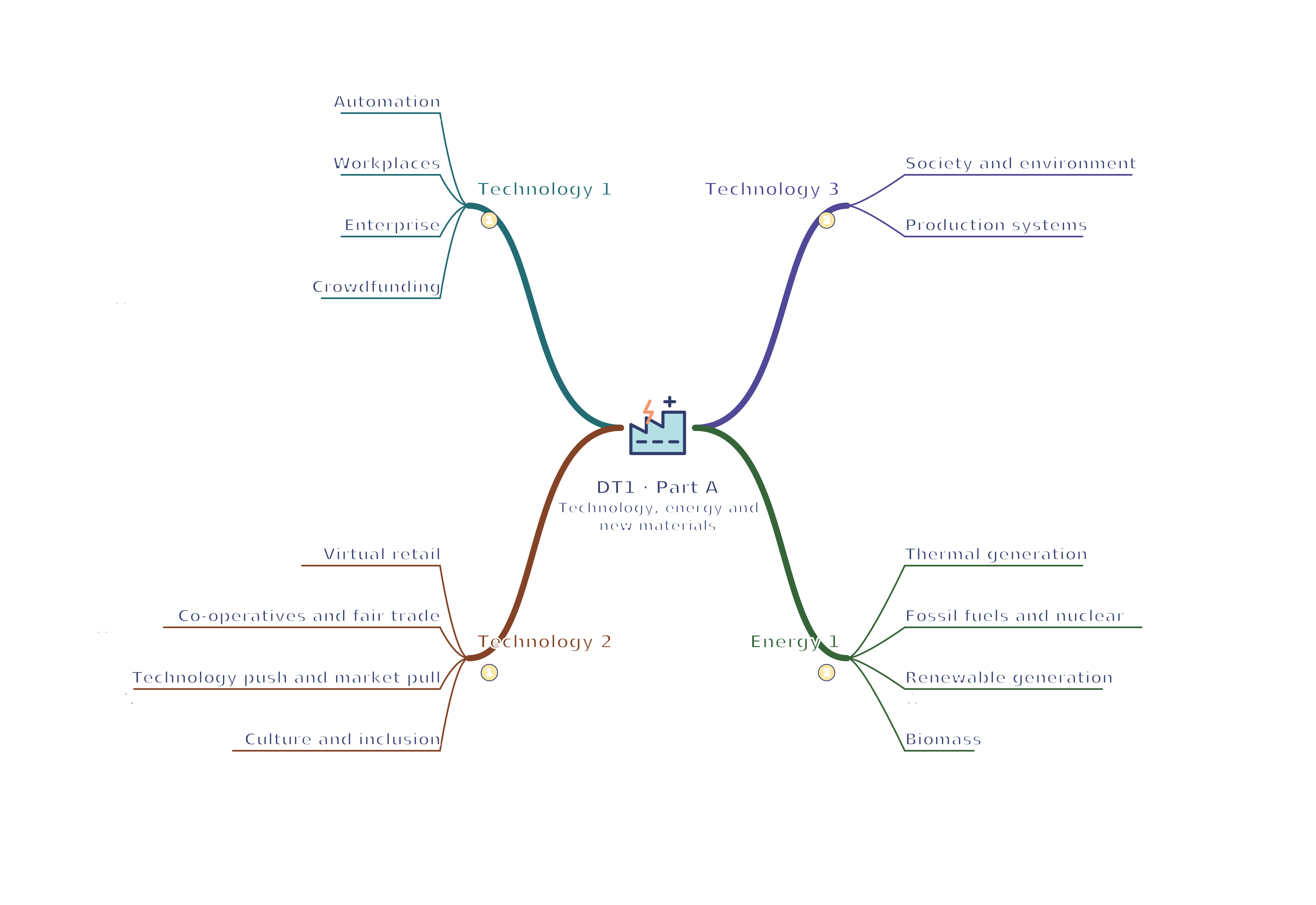
View DT1 · Technology 1 / Technology 2 / Technology 3 / Energy 1 mind mapOpen the full-size map to zoom. Download the PDF to print on A4 or enlarge to A3.
 Mr Kidman's Classroom