Food security, increasing supply and sustainable food schemes.
Notes and quizzes readyOptional · choose 1 of 3
Named examples on this page are revision choices. Use your school’s examples if they differ.
Revise the key ideas
Food security and insecurity
Food security means reliable access to enough safe, nutritious food for an active, healthy life. It involves availability, affordability, suitable use and stability over time.
National food supply can appear adequate while poorer households are food insecure. Unequal income and access matter as much as total tonnes produced.
Average calorie intake varies globally. An average can hide undernutrition among some people and excessive consumption among others; calories alone do not measure diet quality.
Population growth increases the number of people needing food. Rising incomes can increase demand for meat and dairy, whose production often uses feed crops, land and water.
Climate affects crop suitability and growing seasons. Droughts, floods and heat can damage harvests; climate change can alter the risk of these events.
Technology, improved seeds, irrigation and machinery can raise output. Farmers need money, training, maintenance and access to markets to benefit.
Pests and disease can destroy crops or livestock. Depending on one crop increases vulnerability if that crop fails.
Water stress limits irrigation. Pumping beyond replenishment can reduce future supplies and make farming less secure.
Conflict can destroy fields and stores, displace farmers and interrupt transport. Poverty can prevent people buying food even when markets have supplies.
Impacts of insecure food supply
Undernutrition means insufficient energy or nutrients and can weaken immunity, growth and concentration. Famine is an extreme crisis with widespread severe food deprivation and excess deaths.
Poor harvests can raise prices and reduce farm incomes. Households may sell assets or withdraw children from school, making later recovery harder.
Pressure to grow food on unsuitable slopes or overuse land can remove vegetation and increase soil erosion. Losing fertile soil reduces future yields.
Rising prices and unequal access can contribute to social unrest. Food shortages have several interacting causes; avoid explaining every conflict as a food dispute.
Increasing food production
Irrigation supplies water to crops when rainfall is inadequate. It can raise yields or allow another crop, but uses water and can cause waterlogging or salt build-up if badly managed.
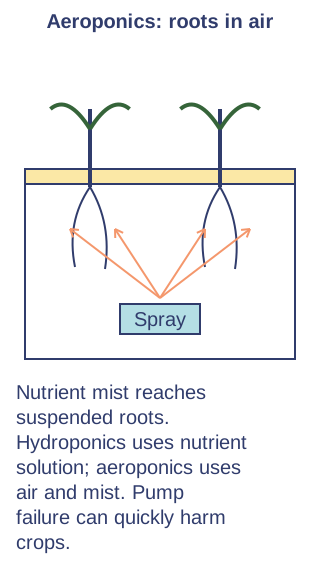
Hydroponics grows plants without soil using a nutrient solution. It allows controlled water and nutrient use, but equipment, energy and technical skills are needed.Growing without soil. Schematic hydroponic system. Aeroponics differs: roots are exposed to air and receive a nutrient mist.
Aeroponics suspends roots in air and sprays them with a nutrient mist. It can use little water but crops can fail quickly if pumps or controls stop working.
Green Revolution approaches combine productive crop varieties with inputs such as irrigation and fertiliser. Increased harvests can come with higher costs, chemical pollution and unequal access.
Biotechnology can develop useful crop traits through scientific techniques. Consider the specific trait, local conditions, seed cost and regulation rather than assuming every modified crop has the same benefits.
Appropriate technology fits local resources and maintenance skills. Composting, small-scale water storage and repairable tools can improve output without expensive infrastructure.
Large agricultural developments can supply many consumers and create processing and transport jobs. They can also displace communities, consume scarce water and damage habitats.
Sustainable food supplies
Sustainable food production aims to maintain output and livelihoods without exhausting soils, water or ecosystems. Evaluate benefits over several seasons rather than one good harvest.
Organic farming restricts many synthetic chemicals and can encourage soil care. Yields, labour requirements and pest problems vary with crop and conditions.
Permaculture designs farming systems around interacting plants, animals, soils and water. Mixed planting, composting and capturing water can reduce external inputs.
Urban farms and community gardens can provide fresh produce and education. They usually supplement a city's food supply rather than replace all farmland.
Sustainable fisheries control catches and protect breeding populations and habitats. Labels and management evidence are more useful than assuming all wild-caught fish are sustainable.
Meat production impacts depend on feed, land, animal care and emissions. Reducing avoidable consumption and waste can lower demand for resources.
Seasonal foods can reduce the need for heated production or long storage. Transport mode and production methods still determine much of the footprint.
Improved drying, refrigeration, packaging and transport reduce losses before food reaches consumers. Meal planning and suitable portions reduce household waste.
Local schemes work best when farmers choose suitable practices, can obtain equipment and retain skills. A scheme's success also depends on rainfall, land rights and access to markets.
Large-scale agriculture: Almería, Spain
Almería in south-east Spain has extensive greenhouse horticulture producing vegetables for Spanish and export markets. Covered growing conditions and controlled inputs help supply crops beyond a short outdoor season.
The production system creates farming, packing, transport and supplier jobs. Reliable output supplies consumers and brings income to growers and the region.
Water scarcity is a major challenge in this dry setting. Irrigation efficiency can reduce water per crop, but extensive production still puts pressure on total supplies.
Greenhouses generate plastic waste and change the landscape. Worker conditions, chemical use and management of used materials affect the social and environmental costs.
Almería demonstrates that increasing output and exports is different from guaranteeing sustainability. Evaluate water sourcing, waste management and who receives the income.
Local sustainable food: farmer field schools in Bukoba, Tanzania
FAO documents farmer field schools in Bukoba district, Kagera, in north-western Tanzania, as part of work on land and water management. Farmers compare practices in plots and choose techniques suited to their conditions.
Observation, trials and discussion can improve soil care and pest decisions instead of applying costly inputs without checking need. Farmers share skills within the community.
Keeping soil productive and using water carefully can support more reliable food production and livelihoods. The approach builds local decision-making rather than depending only on imported equipment.
Results depend on participation, access to land, weather and resources. This is a documented approach used in local schemes, not an invented yield figure or a claim about every Tanzanian farm.
Test yourself
51 questions · Random sets of 10. These quick checks support revision; practise longer explanations and justified judgements too.
Watch G16 · Food
Revise food with this narrated video. Use the player controls to pause, seek, adjust the volume or mute. Turn English captions on or off using the captions menu.
 Mr Kidman's Classroom