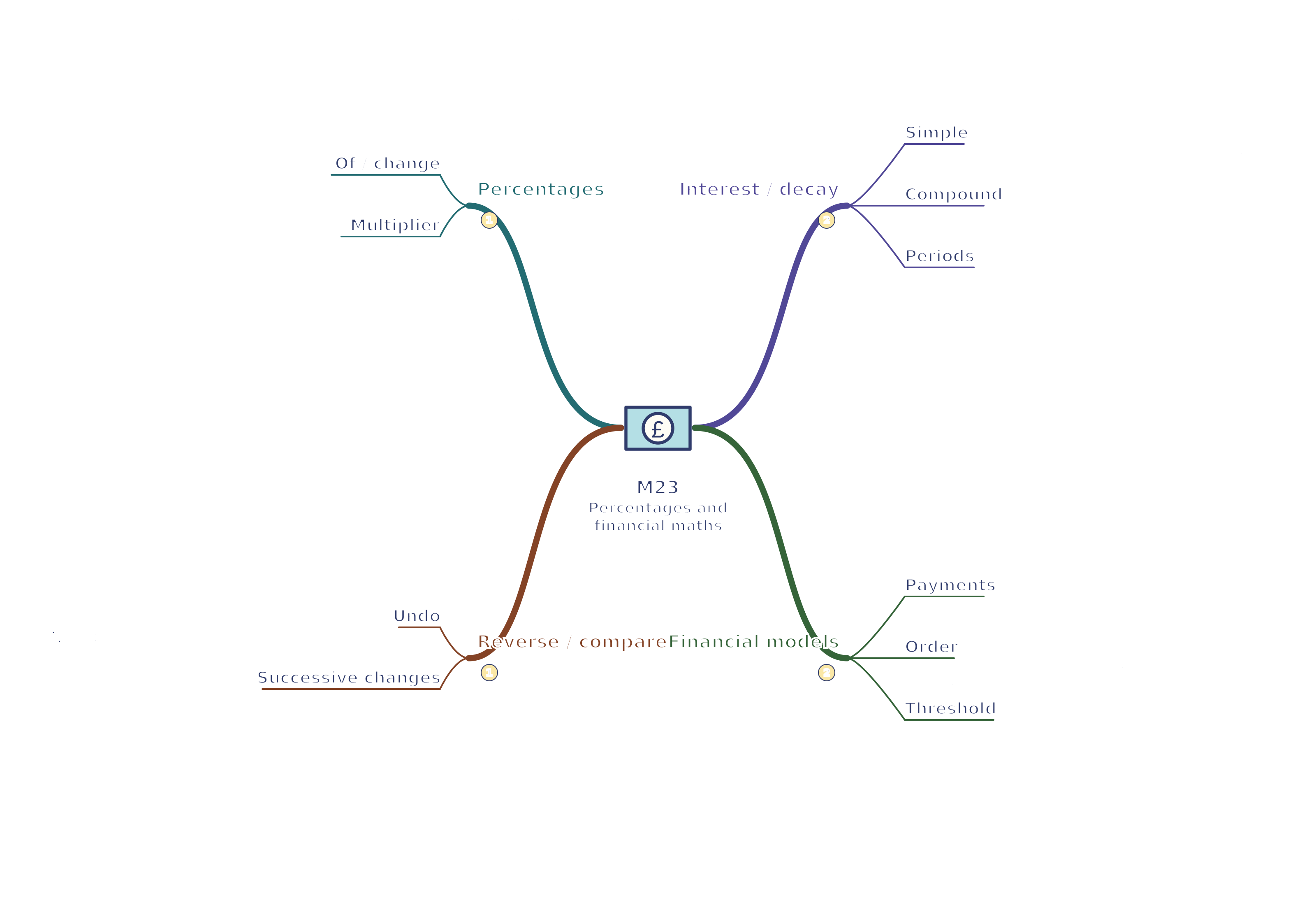
Revision notes, worked examples and methods for percentages and financial maths.
Notes and quizzes ready · 52 questions · Revision video ready.
Foundation shows shared notes and questions. Higher includes the shared content and labelled Higher extensions. Changing tier starts the notes and a new quiz set.
Revise the key ideas
Percentage change
A percentage means parts per hundred. To express A as a percentage of B, use AB × 100%, with B ≠ 0 and matching units.
For percentage change, use changeoriginal amount × 100%. The denominator is the original amount, not the new amount.
Worked example: A price rises from £40 to £46. Increase = £6 and percentage increase = 640 × 100% = 15%.
An increase of p% multiplies by 1 + p100; a decrease multiplies by 1 − p100. A 12% reduction uses multiplier 0.88. Forward and reverse percentage multipliers
Worked example: £250 reduced by 12% becomes 250 × 0.88 = £220. Find the new amount directly with the multiplier.
Reverse percentages and repeated changes
Reverse a percentage change by dividing by its multiplier. A sale price of £72 after a 20% reduction came from 72 ÷ 0.8 = £90.
A 20% rise followed by a 20% fall is not no change: 1.2 × 0.8 = 0.96, giving an overall 4% decrease.
Simple interest is calculated on the original principal every year. At 4% simple interest, £500 earns £20 per year, so after 3 years the total is £560.
Compound interest applies the percentage to the changing balance. Final amount = P(1 + r100)n for n equal periods at rate r% per period.
Worked example: £500 at 4% compound interest for 3 years becomes 500 × 1.043 = £562.432, or £562.43 to the nearest penny. Round the final result, unless the account's rules specify rounding each year.
Depreciation or decay uses a multiplier below 1. A £12 000 car losing 15% of its value each year is worth 12 000 × 0.852 = £8670 after 2 years.
Rates and periods must match: an annual rate is not applied once per month without converting the model. State any assumption that the rate stays constant.
Higher — iterative financial models
If money is added or withdrawn each period, a simple power formula may no longer apply. Write a recurrence that reflects the order of interest and payments.
Worked example: A balance earns 2% interest, then receives a £100 deposit each year. Bₙ₊₁ = 1.02Bₙ + 100. Starting at £500 gives £610 after year 1 and £722.20 after year 2.
Depositing before interest instead gives Bₙ₊₁ = 1.02(Bₙ + 100), a different result. Use the wording to decide the order.
Find an unknown whole number of periods by repeated calculation or trial powers and check the first period at which the threshold is reached. Do not round a time up or down without interpreting the context.
Test yourself
52 questions · Sets of 10 from the selected tier. For fractions, use / when typing; for powers, use superscripts or ^. Follow each question's answer format. These quick checks support revision; practise full written solutions and proofs too.
Watch M23 · Percentages and financial maths
Revise percentages and financial maths with this narrated video. Use the player controls to pause, seek, adjust the volume or mute. Turn English captions on or off using the captions menu.
 Mr Kidman's Classroom