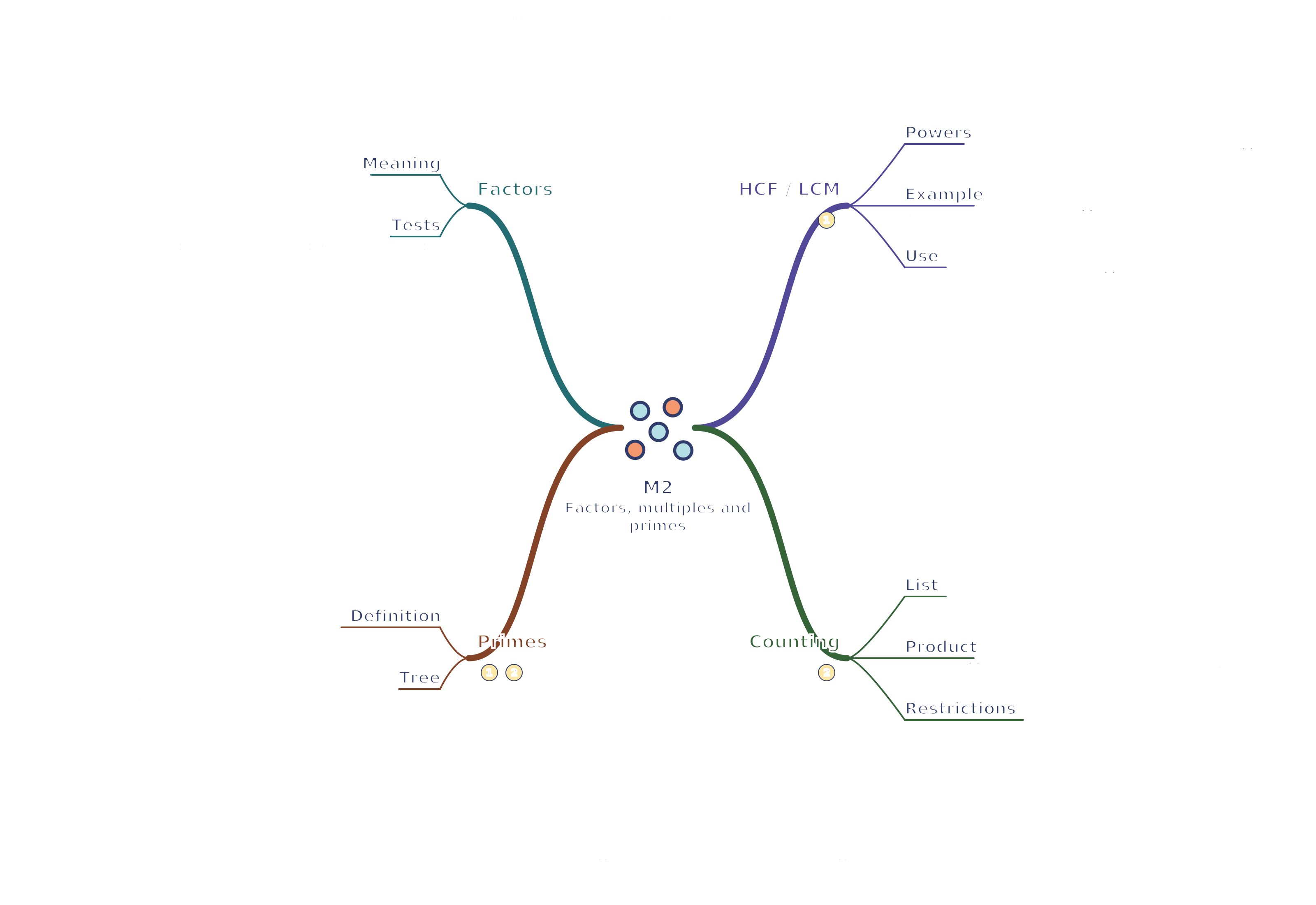
Revision notes, worked examples and methods for factors, multiples and primes.
Notes and quizzes ready · 54 questions · Revision video ready.
Foundation shows shared notes and questions. Higher includes the shared content and labelled Higher extensions. Changing tier starts the notes and a new quiz set.
Revise the key ideas
Factors, multiples and primes
A factor divides a number exactly; a multiple is made by multiplying it by an integer. The positive factors of 12 are 1, 2, 3, 4, 6 and 12; its positive multiples start 12, 24, 36, ….
A prime has exactly two positive factors, 1 and itself. The first primes are 2, 3, 5, 7, 11, 13. The number 1 is not prime and 2 is the only even prime.
Use divisibility tests to find factors: an even number is divisible by 2; a digit sum divisible by 3 indicates divisibility by 3; a final digit 0 or 5 indicates divisibility by 5.
Prime factorisation writes a whole number greater than 1 as a product of primes. A factor tree or repeated division gives 60 = 22 × 3 × 5. The product is unique apart from order. Prime factor tree for 60
The highest common factor (HCF) is the largest factor shared by two or more numbers. In prime factorisations, take only common primes with the smallest shared powers.
The lowest common multiple (LCM) is the smallest positive multiple shared by the numbers. Take every prime that appears, with the largest power needed.
HCF helps divide quantities into identical largest-sized groups: 36 red and 48 blue counters make 12 identical groups, each containing 3 red and 4 blue counters, with none left over.
LCM helps find when cycles coincide. Alarms ringing every 6 and 8 minutes next ring together after 24 minutes, provided they ring together initially.
List outcomes systematically so none are missed or counted twice. With digits 1, 2 and 3 and no repetition, two-digit numbers are 12, 13, 21, 23, 31 and 32.
If order does not matter, AB and BA represent the same pair. State whether repetitions are allowed and whether order matters before counting.
Higher — product rule for counting
If there are m choices for one stage and n choices for the next stage for every first choice, there are mn outcomes. Three shirts and four trousers give 3 × 4 = 12 outfits.
Worked example: A code uses two different letters from A–E followed by a digit 0–9. There are 5 × 4 × 10 = 200 codes. The second letter has only four choices because repetition is forbidden.
For restrictions, split into separate cases or subtract forbidden outcomes. The product rule needs the correct number of choices at every stage; choices need not be statistically independent.
Test yourself
54 questions · Sets of 10 from the selected tier. For fractions, use / when typing; for powers, use superscripts or ^. Follow each question's answer format. These quick checks support revision; practise full written solutions and proofs too.
Watch M2 · Factors, multiples and primes
Revise factors, multiples and primes with this narrated video. Use the player controls to pause, seek, adjust the volume or mute. Turn English captions on or off using the captions menu.
 Mr Kidman's Classroom