Revision notes, worked examples and methods for direct and inverse proportion.
Notes and quizzes ready · 50 questions · Revision video ready.
Foundation shows shared notes and questions. Higher includes the shared content and labelled Higher extensions. Changing tier starts the notes and a new quiz set.
Revise the key ideas
Direct and inverse relationships
Direct proportion means y changes by the same factor as x: y = kx for constant k. The graph is a straight line through the origin. A straight line with a non-zero intercept is not direct proportion. Direct and inverse proportion
Worked example: Five notebooks cost £12.50 at a constant unit price. One costs £2.50, so eight cost £20. Here cost = 2.5 × number of notebooks.
For direct proportion, yx is constant. Doubling x doubles y; tripling x triples y. Test ratios rather than differences.
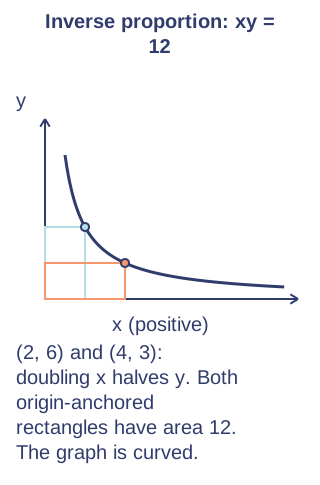
Inverse proportion means y = kx, so xy is constant. For positive quantities, doubling x halves y. Its graph is a reciprocal curve, not a straight line.
Worked example: Four equally productive workers take 9 hours for a fixed job. Six workers take (4 × 9) ÷ 6 = 6 hours, assuming work is shared perfectly and each worker's rate is unchanged.
For a fixed distance, time is inversely proportional to speed. This needs a constant journey length; a general time-versus-speed situation may not be inverse proportion.
Using equations
To use a proportional equation, find the constant from known values, then substitute the new input. Keep the complete relation, not just the value of k.
Worked example: y = 24x. When x = 3, y = 8; when x = 8, y = 3. x = 0 is not allowed.
Read the context carefully: a fixed starting fee, changing productivity or a changing total can invalidate a proportional model.
Higher — powers and constructing models
If y is directly proportional to x2, write y = kx2. If y is inversely proportional to x2, write y = kx2. State which power the question specifies.
Worked example: y ∝ x2, and y = 18 when x = 3. Then 18 = 9k, so k = 2 and y = 2x2. At x = 5, y = 50.
Worked example: y ∝ 1x2, and y = 12 when x = 2. Then k = 48, so y = 48x2. At x = 4, y = 3.
If y ∝ √x and y = 15 at x = 9, then k = 5 and y = 5√x. To find x when y = 20, √x = 4, so x = 16.
Plotting y against x2 gives a straight line through the origin for y = kx2. Its gradient is k. Plotting against 1x does the same for inverse proportion.
Test yourself
50 questions · Sets of 10 from the selected tier. For fractions, use / when typing; for powers, use superscripts or ^. Follow each question's answer format. These quick checks support revision; practise full written solutions and proofs too.
Watch M24 · Direct and inverse proportion
Revise direct and inverse proportion with this narrated video. Use the player controls to pause, seek, adjust the volume or mute. Turn English captions on or off using the captions menu.
 Mr Kidman's Classroom