Revision notes, worked examples and methods for angles, polygons and shape properties.
Notes and quizzes ready · 50 questions · Revision video ready.
Foundation shows shared notes and questions. Higher includes the shared content and labelled Higher extensions. Changing tier starts the notes and a new quiz set.
Revise the key ideas
Lines, angles and polygons
Parallel lines never meet in a plane; perpendicular lines meet at 90°. A vertex is a corner, an edge joins vertices, and a plane is a flat surface. Use conventional labels, for example ∠ABC has its vertex at B.
Angles on a straight line sum to 180°, angles around a point sum to 360°, and vertically opposite angles are equal. A right angle is 90°. Parallel lines and a transversal
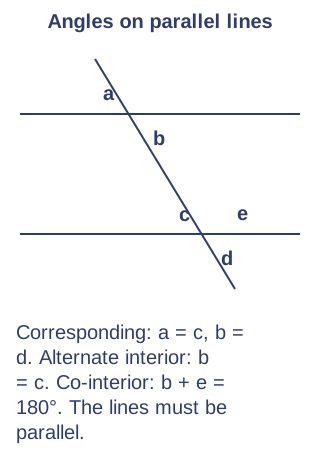
With parallel lines crossed by a transversal, corresponding angles are equal, alternate angles are equal, and co-interior angles sum to 180°. State the parallel-line reason when finding an unknown angle.
A triangle's interior angles sum to 180°. An isosceles triangle has two equal sides and two equal base angles; an equilateral triangle has three equal sides and three 60° angles.
A triangle's exterior angle equals the sum of its two opposite interior angles. If those are 43° and 61°, the exterior angle is 104°.
An n-sided polygon has interior-angle sum (n − 2) × 180°. Divide a polygon into triangles from one vertex to see why this works.
The exterior angles of a convex polygon, one at each vertex in the same turning direction, sum to 360°. For a regular n-gon, each exterior angle is 360°n and each interior angle is 180° minus that value.
Worked example: A regular pentagon has interior-angle sum 3 × 180° = 540°. Each interior angle is 108° and each exterior angle is 72°.
Quadrilaterals and symmetry
Any quadrilateral has interior-angle sum 360°. A parallelogram has parallel opposite sides, equal opposite sides and equal opposite angles; adjacent angles sum to 180°.
A rectangle is a parallelogram with four right angles and equal diagonals. A rhombus is a parallelogram with all four sides equal; its diagonals meet at right angles and bisect each other.
The diagonals of every parallelogram bisect each other. A square's diagonals are equal, perpendicular and angle-bisecting; a rectangle's diagonals are not generally perpendicular. State properties that actually follow from the named shape.
A square is both a rectangle and a rhombus. Its four sides are equal and its four angles are right angles. A kite has two pairs of adjacent equal sides and perpendicular diagonals, with one diagonal bisecting the other.
A trapezium has a pair of parallel sides. An isosceles trapezium has equal non-parallel sides and equal base angles. Use the definition stated in a question if conventions differ.
A line of symmetry reflects a shape onto itself. Rotational symmetry order counts how many times it fits itself during a full turn; a non-square rectangle has order 2.
Worked reasoning
Worked example: In an isosceles triangle with vertex angle 40°, the base angles are equal and total 140°. Each is 70°. Name the equal sides or angle property that justifies equality.
When proving a geometric statement, link each equality to a reason: parallel lines → alternate angles equal → triangle angle sum → required angle. A diagram is not assumed to scale unless the question says so.
Test yourself
50 questions · Sets of 10 from the selected tier. For fractions, use / when typing; for powers, use superscripts or ^. Follow each question's answer format. These quick checks support revision; practise full written solutions and proofs too.
Watch M27 · Angles, polygons and shape properties
Revise angles, polygons and shape properties with this narrated video. Use the player controls to pause, seek, adjust the volume or mute. Turn English captions on or off using the captions menu.
 Mr Kidman's Classroom