Global resource inequalities and the UK's food, water and energy needs.
Notes and quizzes readyCore topic
Revise the key ideas
Resources and wellbeing
Food provides energy and nutrients; water supports health, farming and industry; energy powers heating, transport, machinery and communication. Reliable access helps education and employment.
Supply is the amount available; demand is the amount people want and can obtain. A surplus exists when available supply exceeds demand; a deficit occurs when demand exceeds supply.
Resources are unevenly distributed. Rainfall, geology and soils affect physical supply, while income, infrastructure, technology and governance affect access.
High consumption can reflect wealth and industrial activity. Low consumption may reflect poverty or lack of connections rather than low need.
Resources depend on one another: irrigation uses water and energy, power stations may need cooling water, and producing biofuels can use land that could grow food.Food, water and energy depend on each other. A decision about one resource can affect the others. These are examples of links, not a single direction of causation.
UK consumers buy food grown domestically and food imported from other countries. Imports supply products unsuitable for the UK climate and seasonal produce throughout the year.
Demand for high-value produce from lower-income countries can create jobs and export income. It may also use scarce water and land or expose farmers to changing overseas prices.
Organic food is produced under rules restricting many synthetic inputs. Organic does not automatically mean local, low-carbon or higher yielding.
Food miles are the distance food travels from production to consumption. Long transport routes can increase emissions, especially air freight, but distance alone is not a complete carbon measure.
A food product's carbon footprint includes farming, fertiliser, heating, processing, refrigeration, transport and waste. Local food grown in heated greenhouses can have higher emissions than some imports.
Local and seasonal sourcing can reduce some transport and heating requirements and support nearby farms. Price, availability and production methods still matter.
Agribusiness organises farming as a large commercial operation, often linking production, processing and distribution. Mechanisation and bulk buying can lower costs and raise output.
Large-scale intensive farming can reduce labour needs and pressure small farms. Monocultures, fertiliser runoff and habitat loss require careful management.
Food waste uses resources without feeding anyone. Better storage, clearer planning and using leftovers reduce demand along the supply chain.
UK water supply
Households, farms and industry require water. Population change, lifestyles, irrigation and hotter dry periods can increase demand; efficiency and changes in industry can reduce some uses.
Western and northern UK areas generally receive more rainfall. Drier south-eastern areas have high population and demand, so local supply and demand do not always match.
Seasonal shortages can occur even in a wet country. A reservoir needs rainfall in its catchment, and water available in winter is not automatically available during a dry summer.
Water quality can be harmed by sewage, agricultural fertilisers and pesticides, and industrial discharges. Nutrient pollution can promote algal growth and reduce oxygen available to aquatic life.
Treatment removes contaminants to make water safe for its intended use. Monitoring, sewage treatment and controls on runoff protect supply at its source.
Groundwater abstraction removes water from underground rock. Excessive pumping can lower water tables and reduce flow in rivers or wetlands.
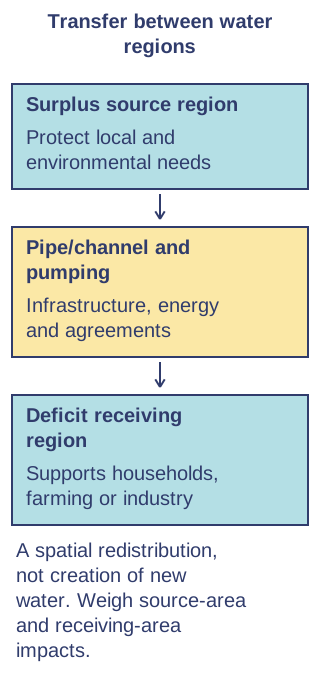
Water transfers move supplies between areas. They can support places in deficit but require pipes or channels, pumping energy and agreements that protect the donor area's needs.
Reservoirs store water for later use. Building them can flood land and habitats, so compare their benefits with leakage reduction and demand management.
Leak repairs, efficient fittings and meters can reduce demand. Charging systems and restrictions should also consider affordability and vulnerable users.
UK energy supply
The energy mix is the combination of sources used. Distinguish electricity generation from total energy use: transport and heating also consume fuels directly.
Coal once played a major role in UK electricity. The last UK coal-fired power station closed in September 2024; this does not mean coal disappeared from every industrial use.
Oil and gas remain important, especially for transport, heating and some power generation. Declining mature UK fields increase pressure to manage demand and obtain supplies elsewhere.
Wind and solar have become more important in electricity production. Their output varies with weather and time, so grids need flexible generation, storage or interconnection.
Nuclear generation uses a finite fuel but emits little carbon dioxide during operation. Construction costs, waste storage and decommissioning are important concerns.
Domestic extraction can create jobs, tax income and supply security. It can also cause landscape disturbance, pollution and greenhouse-gas emissions.
Imports can diversify supply but expose consumers to international prices and disruptions. A diverse mix and lower demand can improve resilience.
Energy choices involve costs, reliability, emissions and local impacts. Insulation can reduce bills and demand without needing an extra power station.
Test yourself
50 questions · Random sets of 10. These quick checks support revision; practise longer explanations and justified judgements too.
Watch G15 · Resource management
Revise resource management with this narrated video. Use the player controls to pause, seek, adjust the volume or mute. Turn English captions on or off using the captions menu.
 Mr Kidman's Classroom