Energy security, energy sources, conservation and sustainable schemes.
Notes and quizzes readyOptional · choose 1 of 3
Named examples on this page are revision choices. Use your school’s examples if they differ.
Revise the key ideas
Energy security and insecurity
Energy security is reliable access to affordable energy supplies. A country can have fuel resources but lack electricity connections or the money and technology to exploit them.
Energy consumption is uneven. Wealthy and industrialised economies generally use more per person, while poorer households may lack modern fuels or reliable electricity.
Population growth raises demand. Economic development and technologies such as air conditioning and digital services can increase it further, while efficiency can reduce energy per task.
Geology determines fossil-fuel deposits; climate and relief influence wind, solar and hydropower potential. A resource's location does not alone make it economic to develop.
Extraction cost, depth, distance and transport infrastructure affect supply. Technology may make difficult resources accessible but can create new environmental risks.
Political instability, conflict, sanctions or disputed routes can disrupt energy trade. A mix of sources and suppliers can reduce dependence on a single route.
Consequences of insecure energy
Higher prices increase household costs and can make heating unaffordable. Businesses may raise prices or reduce production, affecting jobs and living standards.
Power cuts disrupt hospitals, water pumps, factories and communication. Backup generators add costs and can increase local pollution.
Energy is used in fertiliser manufacture, irrigation, food processing and transport. Rising fuel prices can therefore increase food prices.
Demand can encourage extraction in deep oceans, fragile environments or remote areas. Development may increase costs, spill risks and habitat disturbance.
Countries can compete over deposits and supply routes. Trade agreements, cooperation and reduced demand can also improve security.
Non-renewable sources
Fossil fuels include coal, oil and natural gas. They store energy from ancient organic material and form far too slowly to replace current use.
Burning fossil fuels releases carbon dioxide; some processes also release air pollutants. Extraction and transport can cause spills, habitat loss and methane leakage.
Fossil fuels can provide controllable energy and established jobs and infrastructure. Price volatility, finite reserves and climate impacts are major disadvantages.
Nuclear power releases energy from uranium rather than burning fossil fuel. It is non-renewable because its fuel is finite, although operating carbon emissions are low.
Nuclear stations can provide substantial continuous output. High construction costs, long building times, radioactive waste and decommissioning require management.
Renewable sources
Wind turbines convert moving air into electricity. Output depends on wind conditions; landscape, noise and wildlife effects influence siting.
Solar photovoltaic panels convert sunlight into electricity. Solar thermal systems heat water. Night-time and seasonal variation require other supply or storage.
Hydroelectric power uses flowing or falling water to drive turbines. It can offer controllable generation where water storage exists, but dams alter rivers and can displace people.Small-scale hydroelectricity. Water falls through the supply pipe and drives a turbine. The diagram shows a concept, not a particular Nepal installation.
Tidal power uses predictable changes in sea level or tidal currents. Suitable sites are limited and structures can affect estuary habitats and navigation.
Wave power uses movement of sea waves. Exposed sites offer energy but storms, corrosion and maintenance make engineering challenging.
Geothermal energy uses heat from within the Earth. Accessible high-temperature resources are unevenly distributed, and drilling is expensive.
Biomass burns or processes organic material. Regrowth can replace some carbon absorbed by plants, but emissions, land-use change and time to regrow mean it is not automatically carbon-neutral.
Renewable supplies avoid using finite fuel deposits, but construction still uses materials and land. Compare life-cycle impacts, reliability and local conditions.
Reducing energy use
A carbon footprint measures greenhouse-gas emissions associated with a person, activity or product, usually expressed as carbon-dioxide equivalent. It includes more than electricity at home.
Insulation, draught reduction and efficient heating lower building demand. Suitable shading and ventilation can reduce cooling needs without harming indoor air quality.
Efficient appliances, lighting and industrial processes use less energy for the same useful task. Switching unused equipment off reduces avoidable consumption.
Walking, cycling and public transport can reduce transport energy per passenger. Electric vehicles need electricity and materials, so their full impact depends on supply and manufacture.
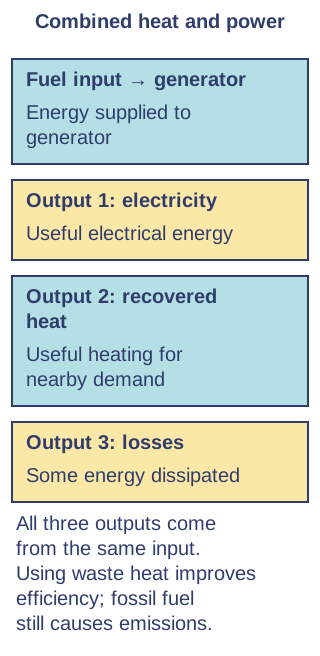
Combined heat and power uses useful heat alongside electricity, reducing waste when there is a nearby heat demand. More efficient fossil-fuel use still produces emissions.
Reducing demand, diversifying supply and improving grid flexibility work together. Energy security and low emissions should be assessed alongside affordability.
Local renewable projects can serve remote communities without waiting for a national grid connection. Maintenance funding, ownership and fair access determine whether benefits last.
Fossil-fuel extraction: oil in the Niger Delta
The Niger Delta in southern Nigeria contains oil fields and associated pipelines and export infrastructure. Extraction brings employment, export income and government revenue and supplies fuel to wider markets.
Suppliers and transport firms can gain work, but not all residents obtain secure skilled jobs. Benefits depend on how revenues and opportunities are distributed.
Oil spills can contaminate soil and waterways and damage fishing, farming and mangroves. UNEP's Ogoniland assessment provides documented evidence from one affected part of the delta.
Gas flaring releases greenhouse gases and other pollutants. Maintenance, regulation, reduced flaring and effective clean-up are needed to reduce harms.
The case shows a conflict between export income and local environmental wellbeing. Some pollution has multiple causes, so avoid attributing every incident to a single company without evidence.
Local renewable energy: micro-hydro in rural Nepal
Community micro-hydro schemes in Nepal use the fall of water in small streams to generate electricity for settlements that may be distant from the national grid. The Alternative Energy Promotion Centre supports this approach.
The Badigaad Micro Hydro Plant in Bajura is a named local example. UNDP documents its supply to households and enterprises and its damage during a 2020 flash flood, followed by rehabilitation through work with AEPC and Japanese funding.
A small intake diverts part of the flow through a channel or pipe to a turbine and generator; water is returned downstream. It does not burn fuel to generate electricity.
Electric lighting and power for small businesses can support study, communication and income. Local operation and repair skills help communities maintain the supply.
Stream flow varies seasonally, and damaged intakes or equipment can interrupt service. Construction finance, maintenance funds and fair tariffs determine whether households can benefit.
Micro-hydro has lower fuel emissions than diesel generation, but diversion can affect stream habitats and competing water uses. Appropriate flow protection and siting remain necessary.
Test yourself
51 questions · Random sets of 10. These quick checks support revision; practise longer explanations and justified judgements too.
Watch G18 · Energy
Revise energy with this narrated video. Use the player controls to pause, seek, adjust the volume or mute. Turn English captions on or off using the captions menu.
 Mr Kidman's Classroom