Explain the methods, show your working and interpret results in context.
Foundation shows shared notes and questions. Higher includes the labelled extensions. Maps and checklist downloads include labelled Higher content; the worksheet generator filters individual goals.
Revise the key ideas
Outcomes and event relationships
Sample spaces — List outcomes systematically, using a table for two dice or two choices. With two fair dice there are 36 equally likely ordered pairs; sums are not equally likely because different numbers of pairs give different sums. Extend trees carefully to at most three events.
Exclusive and exhaustive — Mutually exclusive events cannot occur together; exhaustive events cover every possible outcome. On a die, odd and even are both exclusive and exhaustive. Rolling 1 and rolling 2 are exclusive but not exhaustive. Distinguish these properties before applying an addition rule.
Add exclusive probabilities — For mutually exclusive A and B, P(A or B)=P(A)+P(B). On a die, P(1 or 2)=1/3. Only add disjoint alternatives directly; counting overlapping categories twice can even give an impossible probability above 1.
Independence — A and B are independent when knowing one occurred does not change the other's probability: P(B|A)=P(B), with P(A)>0. For independent events P(A and B)=P(A)P(B). Mutually exclusive events with positive probabilities are not independent.
Tree diagrams — Branch probabilities leaving one node total 1. Multiply along a complete path and add disjoint paths leading to the desired event. Label changing probabilities explicitly; independence is not assumed merely because a tree has the same shape.
Without replacement — From 3 red and 2 blue counters, first red has probability 3/5; after red, second red has probability 2/4. P(two red)=3/5×2/4=3/10. Update both numerator and denominator after removal; replacement would keep the second probability 3/5.Two selections without replacement. Original illustrative diagram; numerical datasets are fictional worked examples.Enlarge diagram
Conditional probability and tables
Conditional notation — P(B|A) means probability of B given A has occurred. Restrict the denominator to outcomes in A: P(B|A)=P(A and B)/P(A), provided P(A)>0. The vertical bar is not division by B, and reversing A and B can change the answer.
Two-way tables — To find P(cycles|Year 10), divide cycling Year 10 pupils by all Year 10 pupils. If 12 of 40 Year 10 pupils cycle, answer 0.3 even if the whole table has 100 pupils. Joint probability instead uses the grand total, giving 0.12.
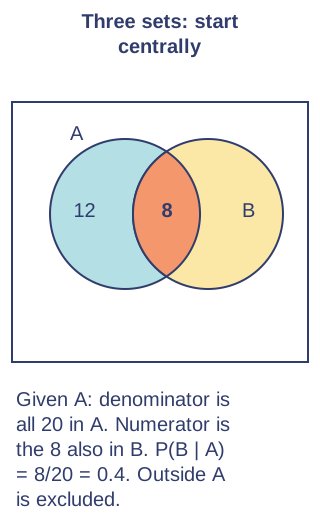
Venn conditional events — Add every region inside the given-event circle for the denominator and take the appropriate intersection for the numerator. If A contains 20 observations and A∩B contains 8, P(B|A)=0.4. Counts outside A do not belong in this denominator.
At least one — Often use the complement: probability of at least one success = 1−probability of none. For two independent trials with p=0.2, answer 1−0.8²=0.36. Exactly one instead includes the two distinct one-success paths and gives 0.32.
Three events — For three independent fair coin tosses there are eight equally likely sequences. Exactly two heads has three paths HHT, HTH and THH, giving 3/8. Write full paths to avoid omission and check the total of all exhaustive paths is 1.
Higher — general addition law
Overlapping alternatives — P(A or B)=P(A)+P(B)−P(A and B). If P(A)=0.5, P(B)=0.4 and overlap=0.2, union probability is 0.7. Subtract the overlap once because it was included in both totals; independence and exclusivity are different possible conditions.
Test yourself
30 questions · Sets of 10 from the selected tier. For fractions, use / when typing; for powers, use superscripts or ^. Follow each question's answer format. These quick checks support revision; practise full written solutions, graph constructions and enquiries too.
Mind map
Use the branches to recall the ideas and explain their connections. Check the revision notes for the full detail.
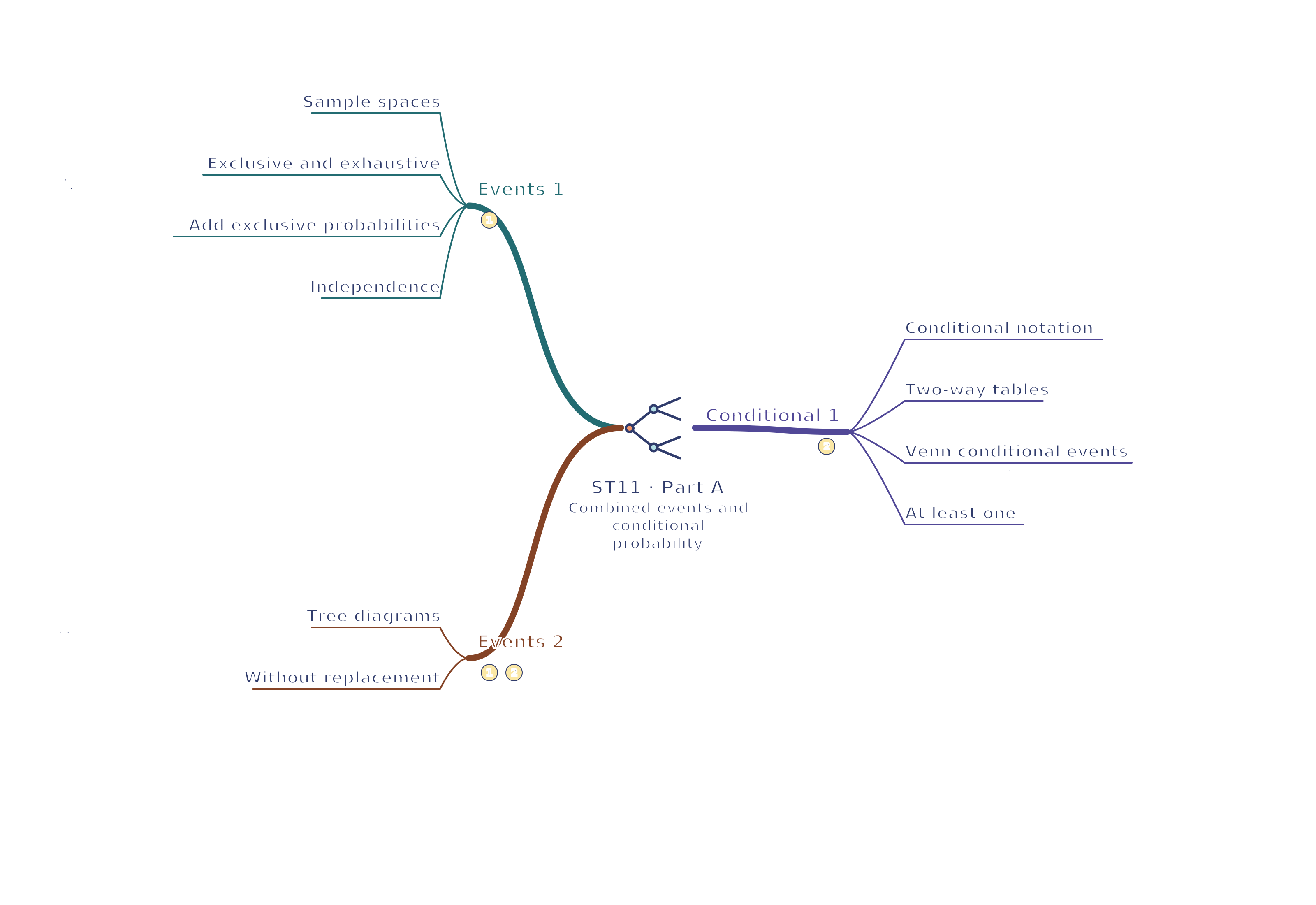
ST11 · Events 1 / Events 2 / Conditional 1
View ST11 · Events 1 / Events 2 / Conditional 1 mind mapOpen the full-size map to zoom. Download the PDF to print on A4 or enlarge to A3.
 Mr Kidman's Classroom