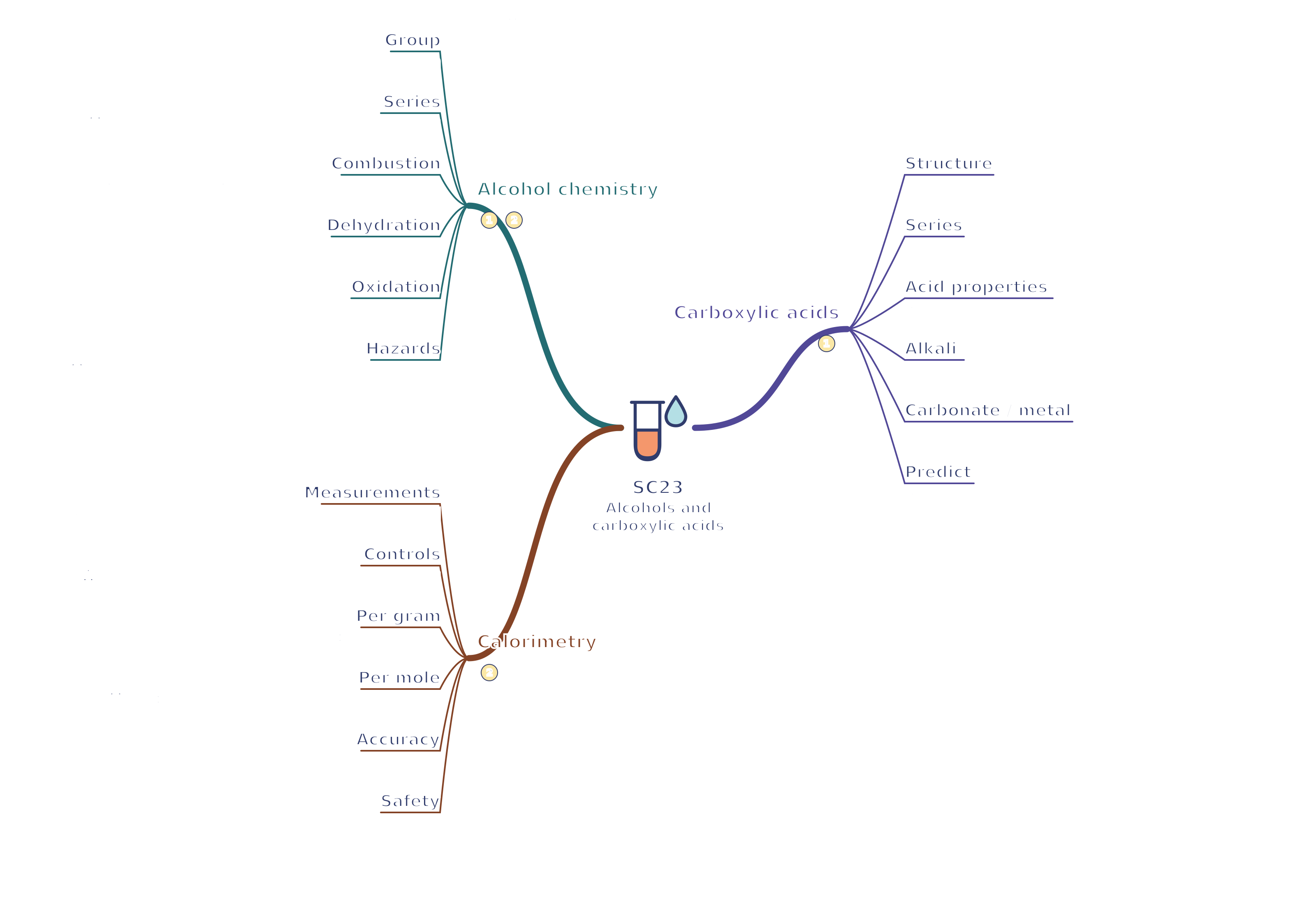
Organic functional groups, alcohol combustion and carboxylic-acid reactions
Revise the key ideas
Alcohol structures and reactions
Alcohols contain the –OH functional group attached to carbon, called a hydroxyl group. A functional group is the part of a molecule responsible for its characteristic reactions. The alcohol’s covalently bonded –OH is different from a free hydroxide ion, OH⁻, in an alkali.
The first four straight-chain primary alcohols here are methanol CH₃OH, ethanol CH₃CH₂OH, propan-1-ol CH₃CH₂CH₂OH and butan-1-ol CH₃CH₂CH₂CH₂OH. Show all atoms and bonds when asked for displayed formulae.The O–H group is bonded to the final carbon; all covalent bonds are shown.
These members belong to a homologous series: they share the –OH group, have similar reactions and differ successively by CH₂. Their boiling points generally rise with chain length.
Alcohols burn in oxygen. Complete combustion produces carbon dioxide and water; ethanol obeys C₂H₅OH + 3O₂ → 2CO₂ + 3H₂O. Insufficient oxygen can produce carbon monoxide or soot.
Alcohols can be dehydrated to form alkenes by removing water. Ethanol forms ethene: C₂H₅OH → C₂H₄ + H₂O. Dehydration is removal of the elements of water, not simply evaporation of solvent.The carbon count is unchanged; an alkene double bond forms.
Ethanol can be oxidised to ethanoic acid. Other suitable primary alcohols can similarly form the carboxylic acid with the same carbon count; the required oxidising reagents are beyond the recall scope here.
Methanol is toxic, and alcohols are flammable. Do not infer that every alcohol has the uses or safety profile of ethanol.
Alcohol combustion: core practical
Compare ethanol, propanol, butanol and pentanol by burning them in spirit burners beneath a known mass of water. Measure initial and final water temperatures and weigh each burner before and after heating.Keep the separation between flame and water container constant.
Keep the water mass, burner-to-container distance, apparatus, starting temperature and mixing method consistent. Stir the water for a representative temperature and use a lid or draught shield where appropriate.
Water energy gain = mass × specific heat capacity × temperature rise. With water mass in g and c = 4.2 J/(g °C), the result is joules; energy per gram burned = energy gained ÷ fuel mass burned.
For comparison per mole, calculate fuel moles from mass/Mᵣ, then divide measured energy by the amount burned. Per-gram and per-mole comparisons answer different questions.
Heat loss to the surroundings and container, incomplete combustion, evaporation of fuel and changes in flame conditions reduce accuracy. A simple apparatus usually captures less than the true combustion energy.
Use repeats and means, identify anomalies and avoid concluding that a larger temperature rise means a better fuel unless the amounts burned and conditions are comparable.
Wear eye protection, keep spare fuel away from flames, extinguish burners safely with their caps and allow hot apparatus to cool. Never refill a burning or hot spirit burner.
Carboxylic-acid structures and properties
Carboxylic acids contain the –COOH functional group: a carbon with a C=O bond and an –OH group. The first four are methanoic acid HCOOH, ethanoic acid CH₃COOH, propanoic acid CH₃CH₂COOH and butanoic acid CH₃CH₂CH₂COOH.The carboxyl carbon has a C=O bond and a C–O–H group. It counts in the chain length.
The carbon in the –COOH group counts towards the molecule’s total carbon number. Ethanoic acid has two carbons, while methanoic acid has one; do not omit the functional-group carbon.
Solutions of carboxylic acids show acidic properties: they turn blue litmus red and react with suitable metals, bases, alkalis and carbonates. Many simple carboxylic acids are weak acids because only some molecules ionise in water.
A carboxylic acid and an alkali form a salt and water; ethanoic acid with sodium hydroxide gives sodium ethanoate and water. The salt name changes the acid ending to -oate.
With a carbonate, a carboxylic acid forms a salt, carbon dioxide and water. Confirm carbon dioxide by its ability to turn limewater cloudy; bubbles alone do not identify a gas.
With a suitable reactive metal, a carboxylic acid forms a salt and hydrogen. Reaction rates depend on the acid and metal; do not claim all metals react equally.
Members of the carboxylic-acid series have similar reactions because they share –COOH. Use the same pattern to predict a reaction of another member.
Watch SC23 · Alcohols and carboxylic acids · Topic 9 — Separate chemistry 2
Revise alcohols and carboxylic acids with this narrated video. Use the player controls to pause, seek, adjust the volume or mute. Turn English captions on or off using the captions menu.
 Mr Kidman's Classroom