Revision notes, worked examples and methods for trigonometry in general triangles.
Notes and quizzes ready · 50 questions · Revision video ready.
This topic is Higher-only.
Revise the key ideas
Higher — choosing a triangle method
For a general triangle, label side a opposite angle A, b opposite B and c opposite C. Matching each side to its opposite angle is essential. Opposite side and angle labels
The sine rule is asin A = bsin B = csin C. It is useful when an opposite side-angle pair and another side or angle are known.
Worked example: A = 30°, B = 45°, a = 6 cm. Then b = 6 sin 45°sin 30° = 6√2 cm ≈ 8.49 cm. The larger angle faces the longer side.
To find an angle using the sine rule, rearrange sin B = b sin Aa and use inverse sine. Check whether the supplementary angle also fits the information.
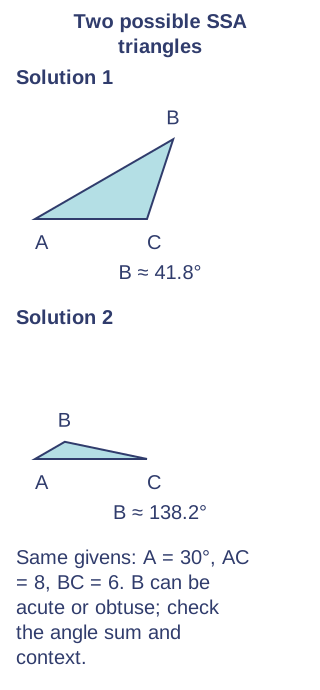
The sine-rule ambiguous case can give two triangles when two sides and a non-included angle are known. An acute calculator answer is not always the only valid angle; use the triangle's angle sum and context.
Higher — cosine rule
The cosine rule is a2 = b2 + c2 − 2bc cos A. Use it for two sides and their included angle, or to find an angle from three sides.
Worked example: Sides b = 5 cm, c = 7 cm enclose A = 60°. Then a2 = 25 + 49 − 70 × 12 = 39, so a = √39 cm ≈ 6.24 cm.
For an angle, cos A = b2 + c2 − a22bc. Use the side opposite A in the subtracted term.
Worked example: For a = 7, b = 5, c = 6, cos A = 25 + 36 − 4960 = 0.2, so A ≈ 78.5°.
Pythagoras is the special case A = 90°, where cos A = 0. The cosine rule extends it to acute and obtuse angles.
Higher — area and applications
Area of a triangle is 12ab sin C, where C is the angle included between sides a and b. A non-included angle cannot be substituted in this form.
Worked example: Two sides 8 cm and 5 cm enclose 30°. Area = 12 × 8 × 5 × sin 30° = 10 cm2.
To find an angle from the area formula, sin C = 2 × areaab. Consider C and 180° − C if both fit the stated triangle.
For bearing problems, first derive the interior triangle angles from north lines. Then use a suitable sine or cosine rule, and convert back to a three-digit bearing if requested.
In three-dimensional problems, first find relevant lengths or plane angles using right triangles, then apply a general-triangle rule if necessary. Keep intermediate values unrounded and use degrees.
Test yourself
50 questions · Sets of 10 from the selected tier. For fractions, use / when typing; for powers, use superscripts or ^. Follow each question's answer format. These quick checks support revision; practise full written solutions and proofs too.
Watch M34 · Trigonometry in general triangles
Revise trigonometry in general triangles with this narrated video. Use the player controls to pause, seek, adjust the volume or mute. Turn English captions on or off using the captions menu.
 Mr Kidman's Classroom