Revision notes, worked examples and methods for powers, roots and standard form.
Notes and quizzes ready · 50 questions · Revision video ready.
Foundation shows shared notes and questions. Higher includes the shared content and labelled Higher extensions. Changing tier starts the notes and a new quiz set.
Revise the key ideas
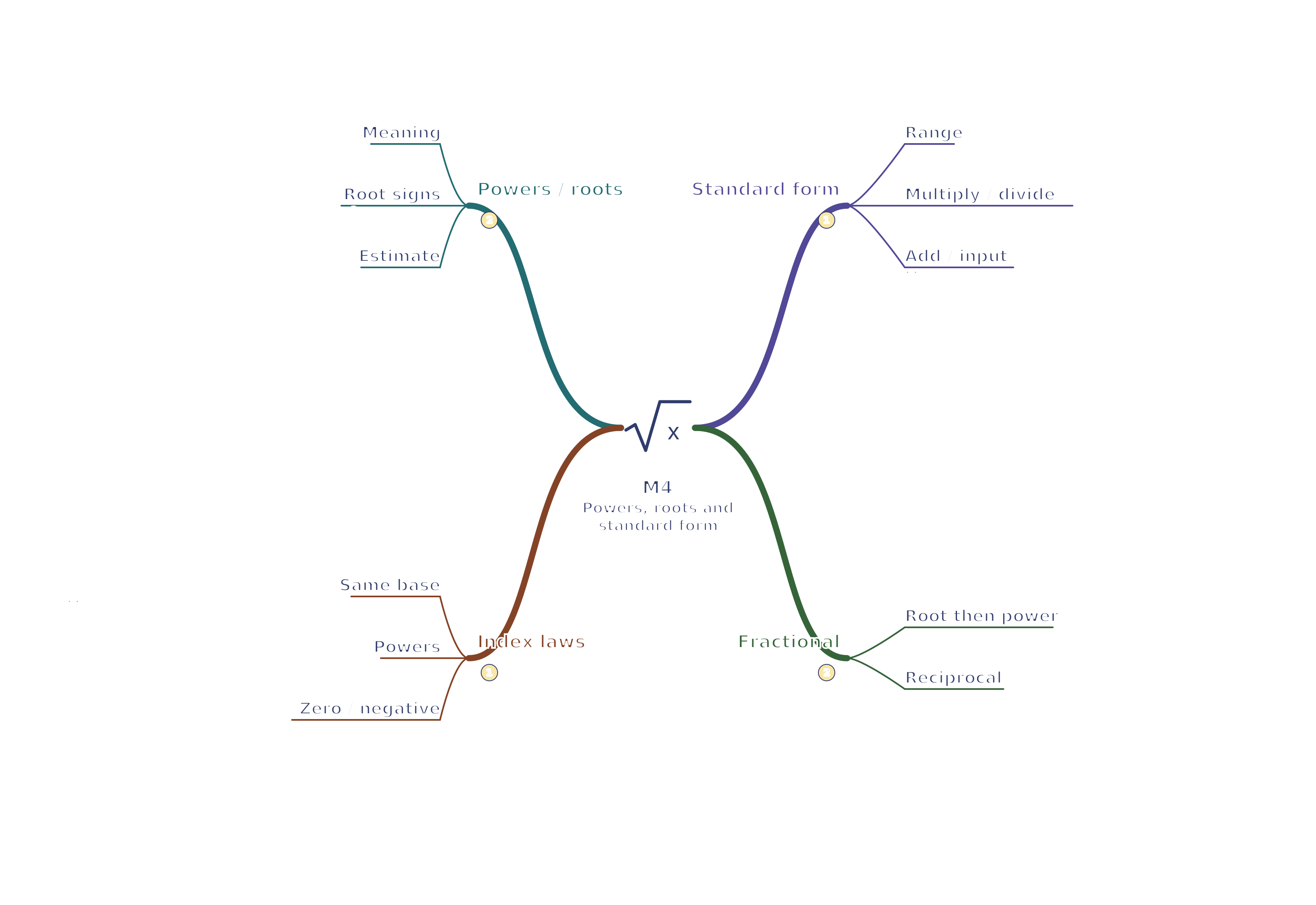
Powers, roots and index laws
In 34, 3 is the base and 4 is the index: 3 × 3 × 3 × 3 = 81. Squaring and cubing mean powers 2 and 3. A power is not base × index.
Square roots undo squaring: √49 = 7. The symbol √ gives the non-negative square root; the equation x2 = 49 has two solutions, x = ±7. Cube roots can be negative: ∛(−8) = −2.
Recognise useful powers: 25 = 32, 33 = 27, 43 = 64 and 53 = 125. Know common squares and cubes so you can undo familiar powers without a calculator.
With the same base, multiply by adding indices and divide by subtracting: aman = am+n; aman = am−n for a ≠ 0.
A power of a power multiplies indices: (am)n = amn. Also (ab)n = anbn. You cannot apply these rules to sums: (a + b)2 is not a2 + b2.
For a non-zero base, a0 = 1 and a−n = 1an. For example, 2−3 = 18. A negative index does not make the value negative.
Standard form
Standard form is A × 10n, where 1 ≤ A < 10 and n is an integer. 43 000 = 4.3 × 10⁴; 0.00072 = 7.2 × 10⁻⁴.
Positive powers of 10 describe large numbers; negative powers describe small positive numbers. 0.003 is 3 × 10⁻³, not −3000.
Worked example: (3 × 10⁵)(4 × 10⁻²) = 12 × 103 = 1.2 × 10⁴. Multiply coefficients, add indices, then adjust the coefficient to the required range.
Worked example:6 × 1072 × 103 = 3 × 10⁴. Divide coefficients and subtract indices.
For addition/subtraction, rewrite with the same power of 10: 3.2 × 10⁴ + 6 × 103 = (3.2 + 0.6) × 104 = 3.8 × 10⁴.
On a calculator, use its standard-form entry key and brackets around complete numbers when dividing. Check whether the displayed exponent is positive or negative.
Higher — fractional indices
Estimate roots using nearby known powers: since 82 < 70 < 92, √70 lies between 8 and 9. Trial values can refine an estimate without implying the root is rational.
For a positive base, a1n means the nth root of a, and amn means raise the nth root to power m. Thus 2723 = (∛27)2 = 9.
Worked example: 16−34 = 1(⁴√16)3 = 123 = 18. Handle the negative sign in the index by taking a reciprocal.
Fractional and negative indices obey the same index laws within their real-number domains. For example, x12 × x32 = x2 for x > 0.
Test yourself
50 questions · Sets of 10 from the selected tier. For fractions, use / when typing; for powers, use superscripts or ^. Follow each question's answer format. These quick checks support revision; practise full written solutions and proofs too.
Watch M4 · Powers, roots and standard form
Revise powers, roots and standard form with this narrated video. Use the player controls to pause, seek, adjust the volume or mute. Turn English captions on or off using the captions menu.
 Mr Kidman's Classroom