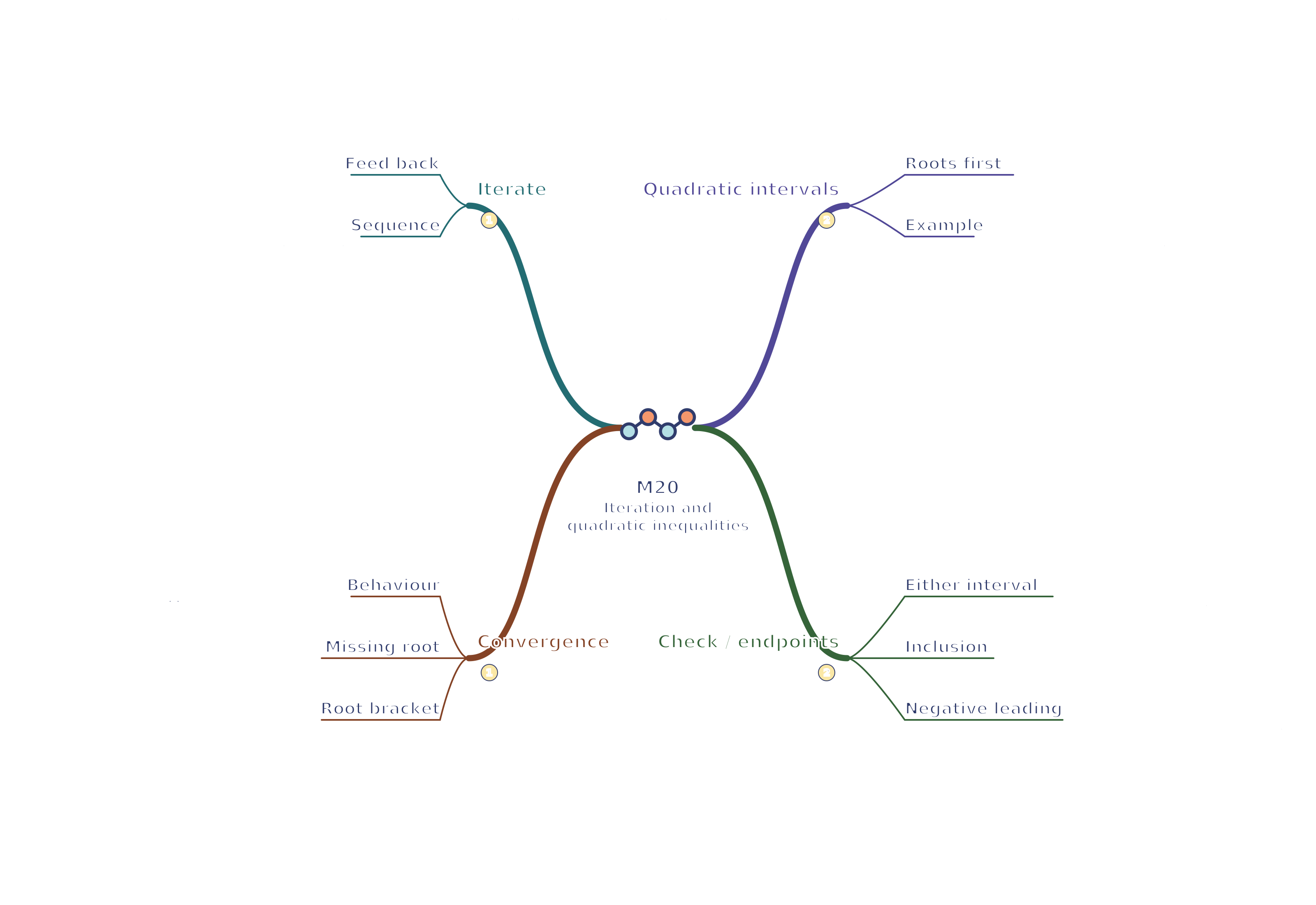
Revision notes, worked examples and methods for iteration and quadratic inequalities.
Notes and quizzes ready · 50 questions · Revision video ready.
This topic is Higher-only.
Revise the key ideas
Higher — iteration
Iteration repeatedly uses a formula to improve or generate values. xₙ₊₁ is the next value calculated from the current value xₙ; x₀ is the starting value.
To solve x2 = x + 2, one possible iteration is xₙ₊₁ = √(xₙ + 2). A rearrangement is chosen, then the result is fed back as the next input.
Worked example: With x₀ = 1, the successive values are x₁ ≈ 1.7321, x₂ ≈ 1.9319 and x₃ ≈ 1.9829; they approach the positive root 2. Keep full calculator precision between iterations.
An iteration can converge, diverge or oscillate. A different rearrangement or starting value may behave differently, so do not assume repeated substitution always solves the equation.
The square-root iteration above cannot find the negative root −1. Always consider the domain and whether other roots may exist.
If asked for a value to a given number of decimal places, check that successive iterates stabilise at that precision; this is numerical evidence, not a guarantee for every iteration scheme.
To locate a continuous function's root by a sign change, find values on opposite sides of zero. For f(x) = x3 − 2, f(1) = −1 and f(2) = 6, so at least one root lies between 1 and 2.
Refine the bracket using trial values. f(1.25) = −0.046875 and f(1.26) = 0.000376, so the positive root lies between 1.25 and 1.26. State your interval and show the signs.
Higher — quadratic inequalities
Find the roots of the associated quadratic equation, then inspect where the graph is above or below the x-axis. The roots divide the number line into intervals. Negative part of x squared minus five x plus six
Worked example: x2 − 5x + 6 < 0 has roots 2 and 3. The upward-opening parabola is negative between the roots, so 2 < x < 3.
For x2 − 5x + 6 ≥ 0, the solution is x ≤ 2 or x ≥ 3. There are two separate allowed intervals; joining them with “and” would be impossible.
With ≤ or ≥ include the roots; with < or > exclude them. Use filled/open endpoints accordingly.
If the leading coefficient is negative, the sign pattern reverses. For 6 − x − x2 > 0, roots are −3 and 2, and the allowed interval is −3 < x < 2.
Check one test value in each interval if unsure. Solving only the boundary equation does not answer an inequality question.
Test yourself
50 questions · Sets of 10 from the selected tier. For fractions, use / when typing; for powers, use superscripts or ^. Follow each question's answer format. These quick checks support revision; practise full written solutions and proofs too.
Watch M20 · Iteration and quadratic inequalities
Revise iteration and quadratic inequalities with this narrated video. Use the player controls to pause, seek, adjust the volume or mute. Turn English captions on or off using the captions menu.
 Mr Kidman's Classroom