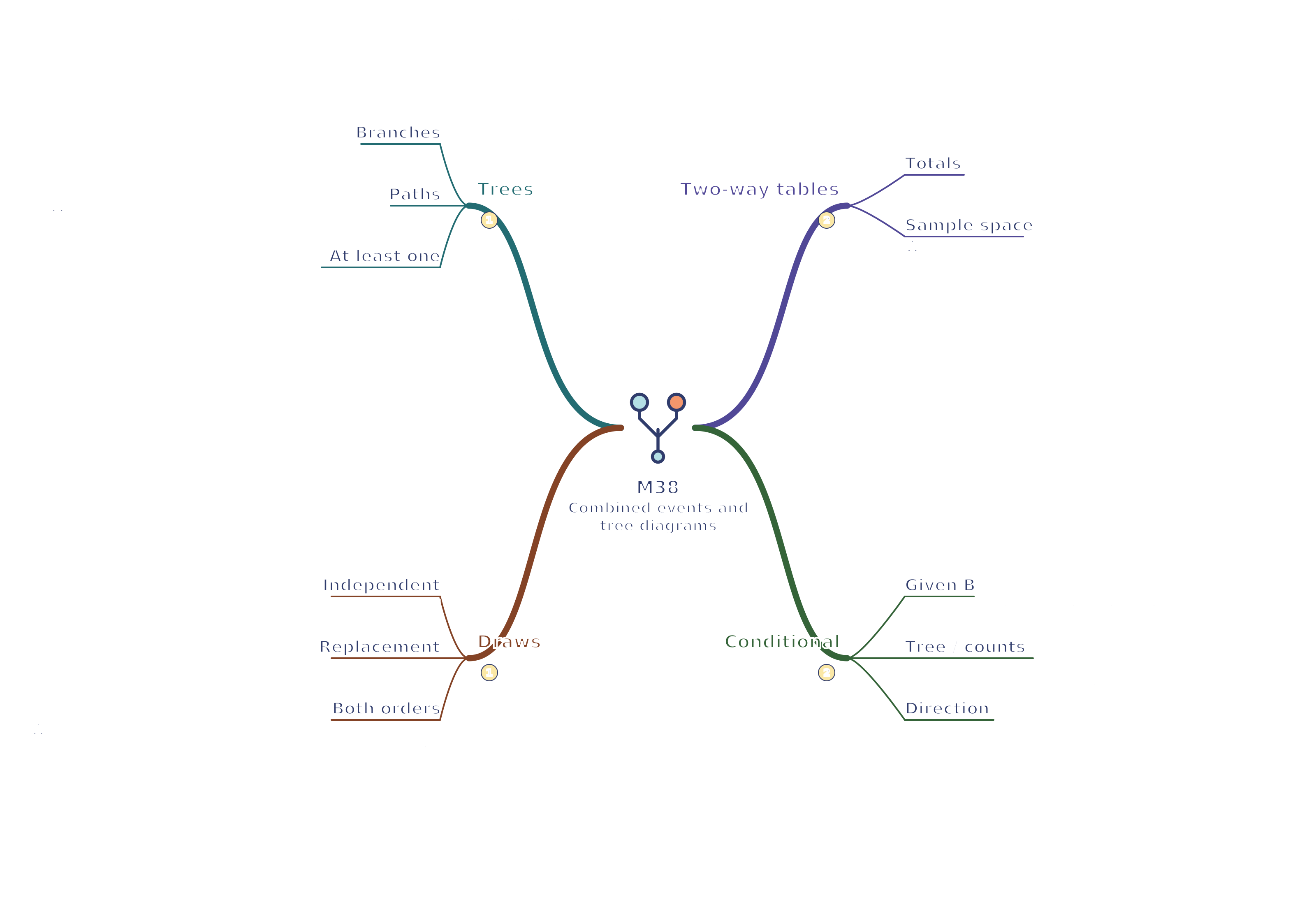
Revision notes, worked examples and methods for combined events and tree diagrams.
Notes and quizzes ready · 54 questions · Revision video ready.
Foundation shows shared notes and questions. Higher includes the shared content and labelled Higher extensions. Changing tier starts the notes and a new quiz set.
Revise the key ideas
Probability trees and combined events
A tree diagram shows successive stages. Label each branch with its probability and each endpoint with its full outcome. Branches leaving one node must have probabilities summing to 1. Two draws without replacement
For a complete path, multiply probabilities along the branches. This uses each stage's appropriate probability given the earlier outcome.
To combine separate mutually exclusive paths, add their probabilities. “And” within a path usually leads to multiplication; “either path” leads to addition.
Independent events do not affect each other's probabilities. For a fair coin and independent fair die, P(head and 6) = 12 × 16 = 112.
With replacement, a random object is returned before the next draw, so the bag's composition is restored. Without replacement, totals and favourable counts change.
Worked example: A bag has 3 red and 2 blue counters. Without replacement, P(two red) = 35 × 24 = 310. The second denominator is 4, not 5.
For the same bag, P(one red and one blue) = 35 × 24 + 25 × 34 = 35. Include both orders.
With replacement, P(two red) would be 35 × 35 = 925. Do not treat draws as independent unless the situation justifies it.
To find “at least one”, sometimes use the complement: P(at least one success) = 1 − P(no successes). This can be quicker than listing many paths.
Two-way tables
A two-way table cross-classifies two attributes. Row totals, column totals and the grand total must agree; derive missing counts before computing probabilities.
For a randomly selected person from the whole group, use the grand total as denominator. Choosing from an already specified subgroup changes the denominator.
Higher — explicit conditional probability
P(A | B) means the probability of A given B has happened. Restrict the sample space to B: P(A | B) = P(A ∩ B)P(B), provided P(B) > 0.
Worked example: Of 30 students, 12 study Spanish and 5 study both Spanish and French. Given a Spanish student is selected, P(French | Spanish) = 512, not 530.
On a tree, later branches already represent probabilities conditional on the route taken. P(A ∩ B) = P(A)P(B | A); for independent events, P(B | A) = P(B).
Use expected-frequency representations for conditional problems when useful. If 1000 items include 100 defective, and a test flags 90 defective and 45 non-defective items, then P(defective | flagged) = 90135 = 23.
Do not reverse a condition: P(defective | flagged) and P(flagged | defective) answer different questions. For the example, the latter is 90100 = 0.9.
Test yourself
54 questions · Sets of 10 from the selected tier. For fractions, use / when typing; for powers, use superscripts or ^. Follow each question's answer format. These quick checks support revision; practise full written solutions and proofs too.
Watch M38 · Combined events and tree diagrams
Revise combined events and tree diagrams with this narrated video. Use the player controls to pause, seek, adjust the volume or mute. Turn English captions on or off using the captions menu.
 Mr Kidman's Classroom